What Happened to Judas: 5 shocking truths revealed
Respuesta Rápida
Judas Iscariot, one of Jesus’s twelve apostles, infamously betrayed Jesus to the authorities for thirty pieces of silver. Overwhelmed by remorse after Jesus’s condemnation, Judas attempted to return the money. According to the Gospel of Matthew, he then hanged himself, a tragic end that underscores the devastating consequences of his actions.
Five shocking truths about what happened to Judas:
- Betrayal for Money: Greed was a primary motive for the betrayal.
- Deep Remorse: He was immediately filled with guilt and regret.
- Suicide by Hanging: Matthew’s Gospel records his death by hanging.
- Alternative Account: The Book of Acts describes him falling and his body bursting open.
- Divine Providence: His betrayal was part of God’s foreknown plan for salvation.
Have you ever found yourself drawn into the dramatic, heartbreaking story of the Passion of Christ, only to be left with a profound and unsettling question: “What happened to Judas?” His name is synonymous with the ultimate act of betrayal, a close disciple who handed his Master over to be crucified. But what really drove him to such a devastating choice, and what became of him after this infamous deed?


Understanding what happened to Judas isn’t just about satisfying a historical curiosity. It’s about grasping a foundational concept that empowers personal reflection, enhances our understanding of the Passion narrative, and deepens our appreciation for the immense cost of redemption. For us here at oracioncristiana.org, exploring such timeless truths strengthens our faith and clarifies our path. You are invited to uncover the 5 shocking truths that reveal what happened to Judas and the powerful lessons his story holds.
1. The Betrayal: Driven by Greed for 30 Pieces of Silver
Before his tragic end, Judas’s journey began with a calculated and chilling decision. Judas Iscariot, one of Jesus’s twelve original disciples and the group’s treasurer, betrayed Jesus to the Jewish religious authorities in exchange for thirty pieces of silver, a price that has become an infamous symbol of treachery.
The Gospels explicitly detail this act of betrayal (Matthew 26:14-16; Mark 14:10-11; Luke 22:3-6; John 13:21-30). While his precise motives are debated, the Gospels strongly point to greed as a primary driver.
“Then one of the Twelve—the one called Judas Iscariot—went to the chief priests and asked, ‘What are you willing to give me if I deliver him over to you?’ So they counted out for him thirty pieces of silver. From then on Judas watched for an opportunity to hand him over.” (Matthew 26:14-16)
This moment highlights:
- Greed as a Motive: The Gospel of John notes that Judas was a thief and used to help himself to the money bag (John 12:4-6), suggesting a pre-existing character flaw.
- Disillusionment: Some scholars suggest Judas may have been a Zealot, disillusioned that Jesus was not the political, revolutionary Messiah he expected.
- Fulfillment of Prophecy: His act, though a free choice, fulfilled Old Testament prophecies (e.g., Zechariah 11:12-13).
Judas’s betrayal was not a spontaneous act but a deliberate choice, driven by a combination of human failings. It’s like a trusted friend, for a small price, leading a sworn enemy directly to your door. This chilling act of treachery set in motion the final, agonizing events of Jesus’s Passion.
2. The Overwhelming Remorse: A Desperate Attempt to Undo the Deed
Immediately following his betrayal, Judas was struck with a profound and devastating sense of guilt. After Jesus was condemned, Judas was seized with overwhelming remorse, desperately attempting to undo his betrayal by returning the thirty pieces of silver to the chief priests and confessing, “I have sinned, for I have betrayed innocent blood.”
This powerful moment of regret is detailed in Matthew 27:3-4:
“When Judas, who had betrayed him, saw that Jesus was condemned, he was seized with remorse and returned the thirty pieces of silver to the chief priests and the elders. ‘I have sinned,’ he said, ‘for I have betrayed innocent blood.'”
This scene reveals:
- Immediate Guilt: The consequence of his action hit him with full force. He recognized the immense gravity of his sin.
- Public Confession: He publicly admitted his guilt to the very people who had paid him.
- Rejection by Accomplices: The chief priests callously dismissed his remorse, saying, “What is that to us? That’s your responsibility.”
Judas’s deep remorse shows that he was not a cold, unfeeling villain. He was a man tormented by the devastating weight of his own choice. It’s like a person who, in a moment of weakness, sets a terrible fire and then, watching the flames consume everything, is filled with a desperate, all-consuming regret. However, his path from remorse to despair, rather than repentance, led to his tragic end. You can explore the psychological aspects of such profound guilt from resources like Psychology Today.
3. The Tragic End: Suicide by Hanging (Matthew’s Account)
Overwhelmed by his guilt and unable to find a path to redemption, Judas’s story culminates in a final act of despair. According to the Gospel of Matthew, Judas Iscariot, in his profound remorse and despair, went away and hanged himself, a tragic end that underscores the devastating spiritual consequences of his betrayal.
After the chief priests rejected his attempt to return the money, Judas’s journey ended in tragedy:
“So Judas threw the money into the temple and left. Then he went away and hanged himself.” (Matthew 27:5)
This account highlights:
- Despair vs. Repentance: Judas experienced profound remorse, but it led to despair rather than true repentance and seeking forgiveness from God (unlike Peter, who denied Jesus but repented and was restored).
- Ultimate Isolation: His final act was one of utter isolation, separating himself from both his former companions and from the possibility of grace.
- Consequences of Sin: His story serves as a powerful cautionary tale about the destructive, self-consuming nature of un-repented sin and guilt.
Matthew’s account is the most well-known and straightforward depiction of Judas’s death. It’s like a story that ends in the deepest darkness, a tragic testament to a soul lost to overwhelming despair. This final act of suicide stands as a somber warning about the path of remorse without hope.
4. A Different Account: The Field of Blood (Acts of the Apostles)
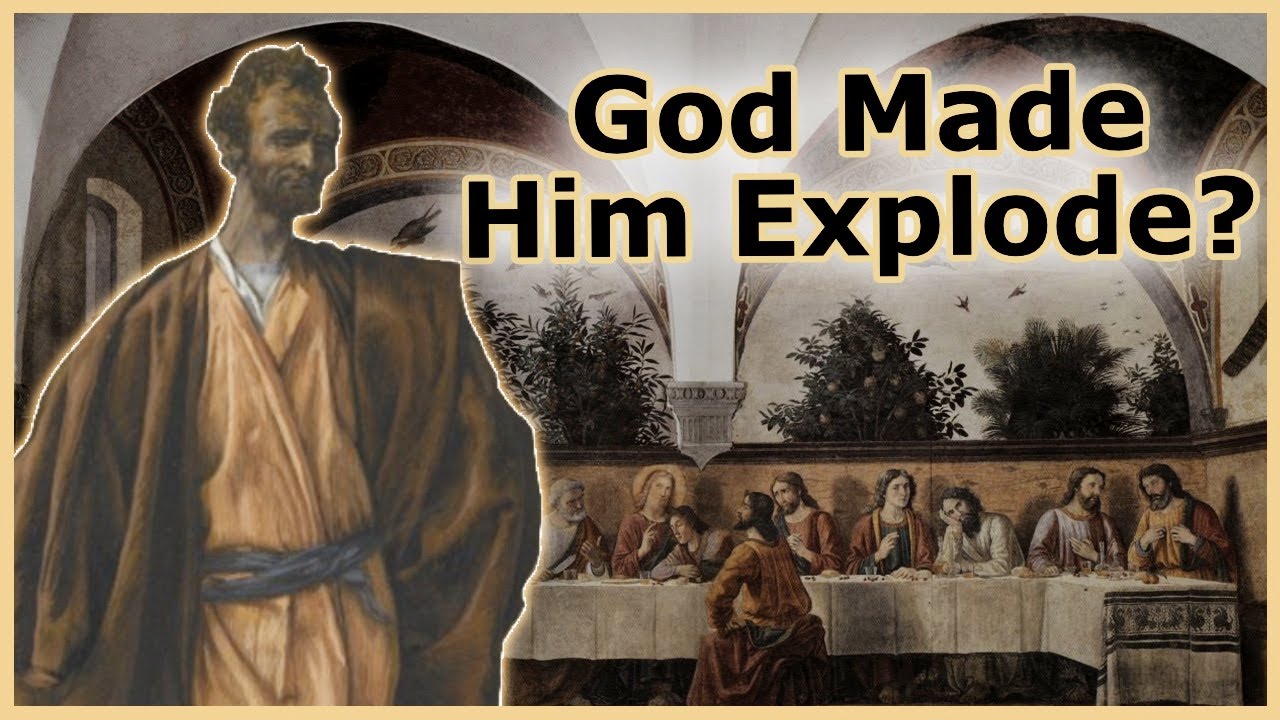
Adding a layer of historical complexity, the Bible provides a second, slightly different account of Judas’s death. The Book of Acts offers an alternative, more gruesome account of Judas’s death, stating that he “fell headlong, his body burst open and all his intestines spilled out” in a field he had bought with his reward.
This account is given by Peter as he addresses the other disciples:
“With the payment he received for his wickedness, Judas bought a field; there he fell headlong, his body burst open and all his intestines spilled out. Everyone in Jerusalem heard about this, so they called that field in their language Akeldama, that is, Field of Blood.” (Acts 1:18-19)
Scholars have long debated how to reconcile these two accounts:
- Two Stages of One Event: Many believe the accounts are complementary. Judas hanged himself (Matthew’s account), and later, his decomposing body fell (perhaps the rope broke), causing it to burst open upon impact (Acts’ account).
- Different Traditions: Others suggest they represent two different early oral traditions about Judas’s death, both emphasizing a gruesome and dishonorable end.
- Symbolic Language: Some elements may be symbolic, emphasizing the horrific nature of his sin.
5. Divine Providence: A Betrayal Within God’s Plan
Perhaps the most profound and mysterious truth about what happened to Judas is that his horrific act of betrayal was not a surprise to God. While Judas acted of his own free will, his betrayal was foreknown by God and was an integral part of His sovereign plan to bring about the crucifixion and, ultimately, the redemption of humanity.
This divine paradox—human free will operating within God’s sovereign plan—is a deep theological mystery. The Bible consistently affirms both:
- Jesus’s Foreknowledge: Jesus knew of Judas’s betrayal in advance, even identifying him at the Last Supper (John 13:21-27).
- Fulfillment of Prophecy: The apostles later recognized that Judas’s actions fulfilled Old Testament prophecies (Acts 1:16, 20).
- God’s Deliberate Plan: Peter declared in his Pentecost sermon: “This man was handed over to you by God’s deliberate plan and foreknowledge; and you, with the help of wicked men, put him to death by nailing him to the cross.” (Acts 2:23)
This does not absolve Judas of his guilt; he was still fully responsible for his choice. However, it reveals the breathtaking sovereignty of God, who can take even the most evil human actions and weave them into His ultimate redemptive purpose. It’s like a master weaver, who can take even the darkest, most tangled threads and incorporate them into a magnificent, beautiful tapestry. This is a profound and shocking truth that underscores God’s ultimate power over history and His ability to bring good out of tragedy.
What Lessons from Judas’s Story Will Guide Your Path Today?
The exploration of what happened to Judas is a sobering and deeply instructive journey. It reveals a story of greed, betrayal, overwhelming remorse, and ultimate despair. Yet, it also illuminates the profound mysteries of divine providence and the devastating consequences of sin when it is not brought to the foot of the cross in true repentance.
May his tragic story serve as a powerful reminder of the importance of integrity, the danger of greed, and the critical difference between worldly sorrow and godly repentance that leads to salvation. What an incredible, though heartbreaking, lesson to ponder!
Now, your thoughts are welcome. The comments section is open!
→ Which of these 5 shocking truths about what happened to Judas resonated most deeply with your understanding or surprised you the most?
→ How does Judas’s story, particularly his remorse leading to despair (unlike Peter’s), challenge or affirm your own understanding of repentance and forgiveness?
→ What’s one practical lesson from Judas’s downfall (e.g., the danger of greed, the need for hopeful repentance) that you feel is most relevant for navigating moral choices in our world today?
Sharing insights can encourage one another in our oracioncristiana.org community, as we seek to learn from these powerful biblical narratives!
