Earliest image of jesus: 5 essential facts – a complete guide
earliest image of jesus: origins, evidence, and meaning
When people ask about the earliest image of jesus, they are really asking two things at once: what the very first depictions looked like, and what those images can tell us about the faith, culture, and art of the earliest Christians. The answer is more complex than a single artefact or a tidy date, because several contenders survive from the second to fourth centuries, ranging from a mocking graffito scratched on a Roman wall to gentle frescoes of a youthful shepherd in the catacombs. In this guide, we explore what scholars mean by the earliest image of jesus, survey the main candidates, and show how to evaluate claims you may encounter online or in the media.
Understanding the earliest image of jesus matters because it reveals how the first generations of believers imagined the Saviour before familiar icon types, such as the Pantocrator or crucifix scenes, became standard. It also helps us see how early Christianity navigated Jewish concerns about images, Greco-Roman visual culture, and the practical realities of worshipping in houses, catacombs, and small chapels rather than grand basilicas.
What do we mean by the earliest image of jesus?
Before deciding which artefact is the earliest image of jesus, it helps to clarify the boundaries. “Earliest” can refer to the oldest surviving example, not necessarily the first ever made. The original Christian communities surely produced artworks that are now lost. “Image” can also be debated: do we count satirical depictions by non-Christians, or only devotional Christian images? And how securely must the figure be identified as Jesus rather than a generic shepherd or philosopher?
What counts as an “image” in this discussion?
Scholars typically include both hostile and devotional portrayals when discussing the earliest image of jesus, provided the figure plausibly represents Christ. That is why a scrawled lampoon like the Alexamenos graffito sits alongside catacomb frescoes. Both show how Jesus was envisioned in the second and third centuries, even if for very different purposes.


Dating, context, and certainty
To argue that something is the earliest image of jesus, experts look for secure archaeological context (where it was found and in what layer), stylistic parallels that fit a known period, inscriptions or symbols that identify Christ, and, where available, scientific tests on pigments, plaster, or stone. The most credible candidates are those recovered in professional excavations with clear documentation.
The first visual traces: candidates for the earliest image of jesus
Several pieces are frequently mentioned when people search for the earliest image of jesus. Each comes from a slightly different place, date, and context, and each contributes a fragment of the larger picture.
The Alexamenos graffito (Rome, c. second–third century)
This crude drawing, scratched on a plaster wall, portrays a man worshipping a crucified figure with a donkey’s head and the caption “Alexamenos worships [his] god”. It is almost certainly a mockery of Christian worship, yet it is still one of the earliest images linked to Jesus. Because it is hostile, it is not an icon, but it shows that even critics associated Christians with a crucified deity by this time. See a clear summary on the Alexamenos graffito overview.
The Good Shepherd in the Roman catacombs (late second–third century)
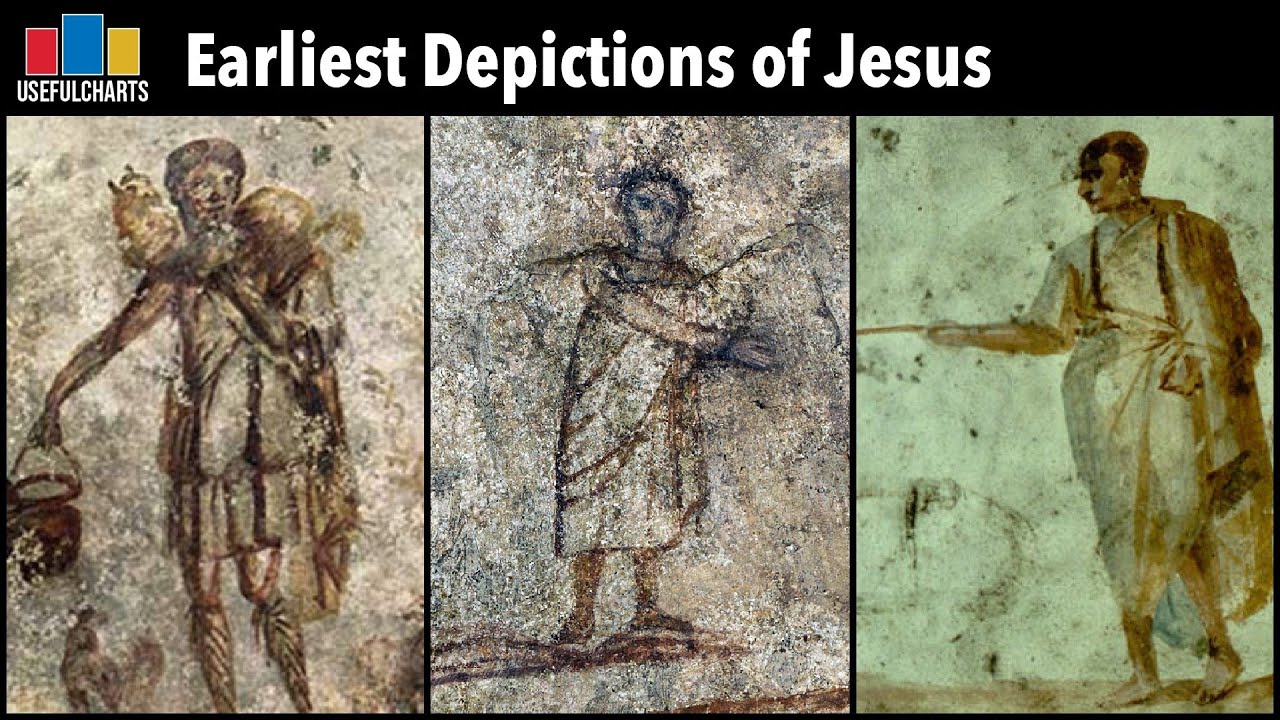
In the catacombs beneath Rome, wall paintings depict a youthful, beardless shepherd carrying a sheep across his shoulders. While the shepherd motif existed in pagan art, Christians adopted it as a discreet reference to Christ as the Good Shepherd. Because these frescoes appear in explicitly Christian burial chambers and are accompanied by other Christian symbols (fish, doves, orans figures), many scholars consider them strong contenders for the earliest image of jesus in a positive, devotional sense. The Catacomb of Priscilla includes classic examples.
The Dura-Europos house-church paintings (Syria, c. 235)
Excavated in the 1930s, the baptistry of the house-church at Dura-Europos preserved painted scenes that likely include Jesus performing miracles, such as healing the paralytic. These are among the earliest narrative Christian images, created in a small worship space rather than a grand church building. Although fragmentary, the paintings are central to discussions of the earliest image of jesus because they show how believers visually taught stories of salvation to catechumens preparing for baptism. An accessible overview is available on the Dura-Europos church page.
The Hinton St Mary Mosaic (Britain, fourth century)
Found in Dorset, this Roman mosaic is widely interpreted as a bust of Christ within a chi-rho symbol, flanked by pomegranates and alpha-omega monograms. While later than the catacombs, it indicates that by the fourth century, recognisable portraits of Christ were used in public or semi-public domestic spaces in the western provinces. It is not the earliest image of jesus overall, but it evidences how imagery spread and diversified. For details, see the Hinton St Mary Mosaic entry.
What did the earliest images look like?
When people imagine the earliest image of jesus, they often expect the familiar bearded face. In reality, the earliest depictions usually show a youthful, beardless figure with short hair and no halo, drawing on Greco-Roman types for philosophers, teachers, or shepherds. Here are the main motifs:
- The Good Shepherd: A young man carrying a sheep. Christian viewers read this through John 10, while outsiders might see a pastoral scene. Its ambiguity helped Christians express faith discreetly in mixed settings.
- The Teacher or Philosopher: A seated or standing figure in a pallium (philosopher’s cloak), with scrolls or hand raised in speech. This aligned Christ with wisdom and instruction.
- The Miracle Worker: Scenes of healing or deliverance (raising Lazarus, the paralytic) were common in baptisteries and funerary contexts, emphasising salvation and new life.
- Symbolic Signs: The fish (ichthys), chi-rho, alpha and omega, anchor, and dove often appeared alongside or instead of figural images.
By the late fourth and fifth centuries, the image of a bearded Christ became dominant, gradually solidifying into the “Pantocrator” type most famously preserved in the sixth-century icon at Sinai. However, that lies beyond the era normally considered for the earliest image of jesus.
Why did images appear, and why then?
Some early Christian writers were cautious about images, mindful of the Second Commandment and wary of idolatry. Others, however, defended images as teaching tools or as expressions of the faith made with reverence. In practice, the Christian approach evolved as congregations spread through the Greco-Roman world, where images filled public life.
Several forces shaped the emergence of the earliest image of jesus:
- Scripture and Liturgy: Stories of healing, shepherding, and resurrection lent themselves to visual summary, especially where new believers learned by seeing as well as hearing.
- Discretion: In times and places of social pressure, symbolic images allowed Christians to communicate faith without drawing dangerous attention.
- Architecture: House-churches, catacombs, and later basilicas offered walls, arches, and baptistery niches that invited painted decoration and narrative cycles.
- Culture: The Greco-Roman visual vocabulary primed viewers to see teachers, heroes, and benefactors in recognisable forms. Early Christian artists adapted these types to present Christ.
How scholars evaluate claims about the earliest image of jesus
New headlines about a “discoverer of the earliest image of jesus” appear from time to time. Here is how professionals assess such claims—and how you can read them critically.
- Provenance: Was the object excavated by archaeologists with clear records, or did it surface on the art market? Secure context strengthens the case.
- Dating: Does stratigraphy, associated finds, stylistic comparison, or scientific testing support the proposed date? Precise dating narrows the field of candidates.
- Identification: Are there inscriptions (e.g., chi-rho, alpha-omega) or narrative cues that clearly point to Christ? A shepherd alone may or may not be the earliest image of jesus unless the context is Christian.
- Comparanda: Does the object fit within known early Christian iconography or is it an isolated anomaly? Parallels help ground interpretation.
- Peer Review: Have findings been published and critically evaluated by other specialists?
Common myths and mistakes about the earliest image of jesus
- Myth: The earliest image of jesus shows a crucifixion. Reality: The earliest crucifixion scenes are late antique (fifth century). Earlier Christian art preferred the Good Shepherd, miracles, and symbols of life.
- Myth: Early Christians had no images at all. Reality: While some communities were cautious, catacomb frescoes and the Dura-Europos house-church prove that images were used within living memory of the apostolic period’s close.
- Myth: A single artefact can be crowned definitively as the earliest image of jesus. Reality: Multiple candidates, each with different strengths, compete within a narrow time window from the late second to early third century.
- Myth: The earliest image of jesus must match later portraits. Reality: Early depictions are often beardless and youthful; the familiar bearded type emerged later.
- Myth: If a piece looks ancient, it must be ancient. Reality: Context, testing, and scholarly consensus matter more than appearances.
What these images tell us about the first Christians
Looking across the candidates for the earliest image of jesus, a coherent picture emerges. Early believers expressed their faith with discretion and creativity, blending scriptural themes with visual forms their neighbours would recognise. They focused on Jesus as shepherd, teacher, and healer—roles that conveyed care, wisdom, and power to save—long before emphasising the drama of the Passion in visual art.
These choices were not evasions of the cross; rather, they were pastoral and liturgical decisions. Baptisteries, tombs, and house-church walls invited images that taught hope, resurrection, and new life, and those themes found their most immediate expression in miracles and pastoral care.
How today’s traditions frame early images
Debates over images later grew into major differences in Christian practice, especially between traditions that encourage icons and those that are more restrained. For a concise primer on how two major branches articulate their positions and histories, see Orthodox vs Catholic: key differences at a glance. Although this is about theology and practice rather than archaeology, it helps to understand why the earliest image of jesus is still discussed with interest across traditions today.
Similarly, conversations about how Christian feasts adopted and transformed existing cultural symbols can illuminate how early communities approached images and meaning. For related context, you might want to read Is Easter pagan? history and Christian origins.
Recommended external resources
- Detailed introduction to the Alexamenos graffito
- Overview of the Dura-Europos house-church and its paintings
- Catacomb of Priscilla: early Christian frescoes and symbols
- Hinton St Mary Mosaic: a fourth-century portrait of Christ
Frequently asked questions about the earliest image of jesus
Is the Alexamenos graffito the earliest image of jesus?
It is one of the earliest depictions that almost certainly refers to Jesus, but it is hostile rather than devotional. Because it is a mockery of Christian worship, some people prefer to reserve “earliest image of jesus” for positive, Christian-made works, such as the Good Shepherd frescoes. In either case, the graffito demonstrates that outsiders associated Christians with a crucified figure by the second or third century.
