Prayer to mother mary undoer of knots: essential guide – 5 steps
prayer to mother mary undoer of knots
The prayer to mother mary undoer of knots is a beloved Christian devotion that invites the intercession of the Virgin Mary to help unravel the complicated “knots” in our lives—those stubborn problems, anxieties, sins, or relationship tangles that feel impossible to fix on our own. In this friendly, step-by-step guide, you will learn what the devotion is, where it comes from, how to pray it simply and meaningfully, and how to avoid common mistakes so the practice remains authentic, hopeful, and grounded.
Whether you are facing a delicate family situation, ongoing conflict at work, a habit you cannot shake, or a heavy concern for a loved one, the prayer to mother mary undoer of knots offers a gentle, faith-filled path to clarity and peace. It is not magic or superstition; rather, it is a sincere appeal to God through Mary’s care, trusting that complex knots can be loosened with patience, prayer, and wise action.
What is the prayer to mother mary undoer of knots?
At heart, the prayer to mother mary undoer of knots calls on Mary as a compassionate mother who carefully unties the knotted threads of our lives. The “knots” can be anything that binds or entangles our hearts: confusion, resentment, addictions, spiritual dryness, family estrangement, debt worries, or bureaucratic obstacles. The devotion encourages Christians to name a specific knot, ask Mary’s intercession, and actively cooperate with grace as the situation evolves.
Many people practise this devotion as a daily prayer or as a novena over nine days. Others weave it into the Rosary, pausing briefly at each decade to present a knot and to ask for perseverance. In every form, the prayer to mother mary undoer of knots fosters trust, patience, and openness to the practical steps that might be needed alongside prayer.

Origins and meaning of the devotion
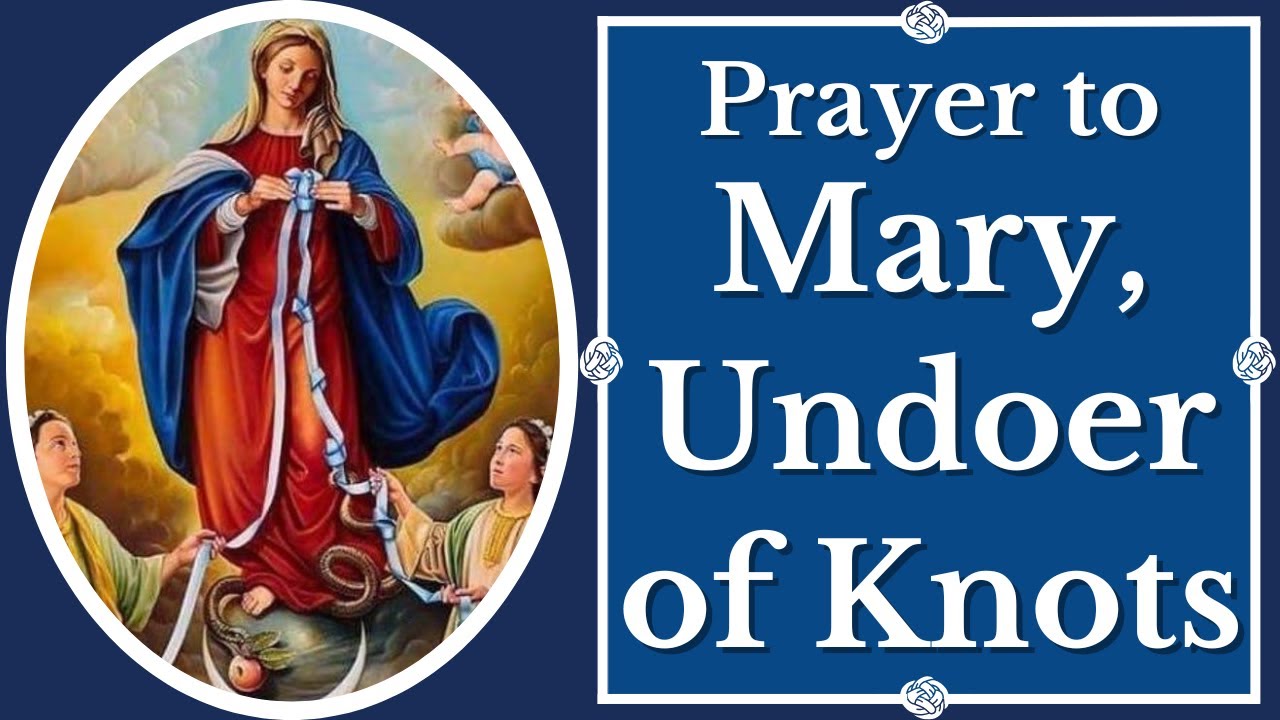
The modern popularity of this devotion traces back to a Baroque painting in Augsburg, Germany, generally attributed to Johann Georg Melchior Schmidtner (c. 1700). The painting depicts Mary untying knots in a ribbon, surrounded by angels, with the Holy Spirit above. The imagery links to a line from St Irenaeus: “The knot of Eve’s disobedience was untied by Mary’s obedience.” You can read more about the history and symbolism in the overview at Mary, Undoer of Knots (Wikipedia), which summarises key points of the devotion.
The devotion received renewed attention in the late twentieth century, in part because Jorge Mario Bergoglio (later Pope Francis) encountered the image while studying in Germany and helped spread awareness of it upon returning to Argentina. He has since encouraged trustful prayer under this title in moments of crisis; for example, he led the faithful in asking Mary’s help during the pandemic, as covered by Vatican News reporting on Pope Francis’s prayer to Our Lady Undoer of Knots. This renewed interest has helped many people discover the prayer to mother mary undoer of knots as a tender, accessible way to approach God in difficult times.
Why people turn to this prayer today
Life’s knots can feel overwhelming. A conversation that should be simple becomes fraught. A decision that ought to be clear becomes messy. Our emotions and responsibilities pull in different directions. The prayer to mother mary undoer of knots resonates because it acknowledges that some complications are too tight to resolve by force. We need patience, insight, and grace. People find comfort in the idea of Mary carefully loosening each knot with attentive love—as if saying, “Let us do this together, one thread at a time.”
Common reasons to begin the prayer include strained family relationships, blocked communication, lingering guilt, forgiveness that feels out of reach, career confusion, discernment about life choices, healing from past wounds, and the desire to change persistent habits. The prayer to mother mary undoer of knots does not promise quick fixes; it invites peace of heart, renewed wisdom, and gentle progress, often alongside practical steps such as counselling, reconciliation, or professional advice.
How to pray: a simple guide to the prayer to mother mary undoer of knots
You do not need a special book or elaborate ritual to start. What matters most is honest intention, trust in God, and a quiet moment to focus. Here is a simple approach to the prayer to mother mary undoer of knots that you can adapt to your situation.
- Settle into silence. Find a quiet space. Breathe slowly, make the Sign of the Cross if you wish, and acknowledge God’s loving presence.
- Name the knot. Briefly describe the specific knot you are bringing. Clarity helps your prayer become concrete and hopeful.
- Begin your prayer to mother mary undoer of knots. Speak to Mary as a mother. Ask her to take the knot in her hands, to obtain light from the Holy Spirit, and to guide your next steps.
- Use a short prayer you can remember. For example: “Mary, Gentle Mother, Undoer of Knots, I place this tangled situation into your hands. Please intercede for me, that I may receive wisdom, courage, and peace. Help me to act with love, to accept what I cannot change, and to persevere in hope. Amen.”
- Be attentive to promptings. After you pray, spend a minute in stillness. Note any nudge to forgive, apologise, seek advice, or try a small next step. Grace often works through gentle suggestions.
- Repeat daily, if helpful. Many people pray this devotion for nine days (a novena), or every day for a season, holding the same knot until it eases—or moving to a new one when the time feels right.
- Thank God for progress. However small the change—greater patience, a kinder tone, a new idea—give thanks. Gratitude keeps the heart supple while the knot loosens.
If you prefer a set format, there are established versions of the novena and invocations to Our Lady under this title. For a traditional text many people use, see the EWTN novena to Our Lady Undoer of Knots. Whether you follow a printed formula or pray spontaneously, the heart of the devotion remains the same: trust, clarity, and perseverance.
Praying a nine-day novena without stress
Here is a calm, uncomplicated way to shape a novena using the prayer to mother mary undoer of knots:
- Day 1: Trust — Ask for trust in God’s timing and mercy.
- Day 2: Light — Seek clarity for the next small step.
- Day 3: Courage — Request strength to do what is right.
- Day 4: Patience — Embrace steady progress over quick fixes.
- Day 5: Forgiveness — Ask for the grace to forgive or apologise.
- Day 6: Humility — Welcome advice and correction where needed.
- Day 7: Perseverance — Keep going even when nothing seems to change.
- Day 8: Gratitude — Notice small signs of peace or goodwill.
- Day 9: Surrender — Entrust the outcome to God with confidence.
You can adapt this outline to your own needs. The steady rhythm of prayer—and the honest naming of your knot—are what matter most.
Using the devotion within the Rosary
Some people integrate the prayer to mother mary undoer of knots into the Rosary by presenting a knot at the start of a decade and returning to it briefly after the ten Hail Marys. Others tie a small ribbon around their rosary beads as a simple reminder that prayer and patience work together. If you are new to the Rosary, you can find a practical guide at the US bishops’ website: How to pray the Rosary (USCCB). This can provide structure while you hold your intention before God.
Whether you use the Rosary or a simpler daily routine, keep the focus on heartfelt trust. The prayer to mother mary undoer of knots is especially powerful when combined with concrete acts of love—an encouraging message, a difficult but necessary conversation, or choosing to pause before reacting.
Common mistakes to avoid with the prayer to mother mary undoer of knots
- Treating it like a magic formula. The prayer to mother mary undoer of knots is not about twisting God’s arm but about opening your heart to grace and wise action.
- Never specifying the knot. Vague intentions are hard to address. Be simple and specific: a conversation, a habit, a choice.
- Ignoring practical steps. Sometimes the answer to prayer includes booking a counselling session, drafting a budget, or scheduling a calm meeting.
- Rushing the process. Knots take time. Expect gradual change and celebrate small steps.
- Shouldering it alone. Let trusted friends, mentors, or professionals support you alongside your prayer.
- Overloading with too many knots at once. If you feel overwhelmed, choose one knot to focus on for a while.
Practical examples of “knots” and how to approach them
To make the prayer to mother mary undoer of knots concrete, here are a few realistic scenarios and ways you might pray and act:
- Family tension over an old grievance. Your prayer: “Undoer of Knots, soften our hearts and show me the right time and tone.” Your action: Write a short, respectful message to open a conversation; set boundaries that protect peace.
- Financial stress and disorganised paperwork. Your prayer: “Mary, help me find clarity and discipline.” Your action: Set aside one hour to sort documents; call a free advice service; create a simple two-column budget.
- Workplace misunderstanding. Your prayer: “Undoer of Knots, guide me to speak truthfully and kindly.” Your action: Ask a colleague to role-play the conversation; request a brief, focused meeting with your manager.
- A persistent habit that undermines health or relationships. Your prayer: “Gentle Mother, strengthen my resolve.” Your action: Replace one trigger routine with a healthier option; consider professional help; enlist an accountability partner.
- Discernment about a major decision. Your prayer: “Mary, obtain light and peace beyond my fears.” Your action: List pros and cons; ask two wise people for their perspective; set a reasonable decision date.
Tips to deepen your devotion without overcomplicating it
It is easy to complicate spiritual routines. The prayer to mother mary undoer of knots works best when it remains sincere, simple, and consistent. Try these suggestions:
- Pick a regular time. A five-minute routine at the same time each day builds steady trust.
- Use a small symbol. A ribbon on your desk or a knot in a string can remind you to pause and pray.
- Journal briefly. Jot a one-sentence note after each prayer: “Today I felt encouraged to apologise,” or “I sensed I should wait a week.”
- Combine with Scripture. Read a short verse about trust or peace and let it shape your intention.
- Be kind to yourself. Self-criticism tightens knots; humility paired with compassion helps loosen them.
- Stay connected. A faith community, a friend, or a mentor can keep you encouraged when progress feels slow.
Historical and spiritual notes to enrich your practice
The image of Mary untying knots is rich with biblical and patristic resonance. St Irenaeus’s insight contrasts Eve’s disobedience with Mary’s faithful “yes” to God, showing how pride’s knots are undone by humility and love. This helps us remember that the prayer to mother mary undoer of knots is ultimately about learning Mary’s way of trusting God in complicated moments. Her care is personal, but it always leads us towards Christ, deeper freedom, and practical charity.
Because this devotion is so accessible, communities around the world have adopted it in parish life, family prayer, and individual healing. The fact that it can be prayed in a minute or woven into a nine-day novena makes it highly adaptable—an honest, prayerful companion for everyday life’s challenges and decisions.
Further reading and respected sources
To explore traditional texts, historical background, and pastoral reflections that support the prayer to mother mary undoer of knots, the following are helpful starting points: the concise overview at Wikipedia’s article on Mary, Undoer of Knots, the EWTN novena text and guidance, and Vatican News coverage of Pope Francis’s encouragement. These resources offer perspective without replacing the simple, heartfelt way you can begin right now.
Related articles
Frequently asked questions about prayer to mother mary undoer of knots
Is the prayer to mother mary undoer of knots only for Catholics?
No. While it is a Marian devotion widely loved within the Catholic Church, any Christian who is comfortable asking Mary to pray for them can use it. The focus is on entrusting a knot to God through Mary’s intercession, with humility and trust.
Do I need a specific, official text to pray it correctly?
There is no single mandatory wording. Many people appreciate a set novena, such as the one provided by EWTN, but you can also speak to Mary in your own words. What matters is sincerity: name the knot, ask for light and perseverance, and remain open to grace.
How often should I pray, and for how long?
There is no strict rule. A common pattern is a nine-day novena, but you may continue daily for longer if helpful. Some prefer a simple one- or two-minute prayer at the start or end of the day; others integrate it into the Rosary.
Can I pray for more than one knot at a time?
You can, but it is usually more peaceful to choose one knot and stay with it for a period. If several issues feel urgent, list them and select the one with the most immediate need. After a season of progress, you can move to the next.
What if I do not see any change?
Be patient. Knots often loosen before they untie. Look for subtle shifts—more peace, better conversations, a fresh idea, or a new perspective. Combine the prayer to mother mary undoer of knots with practical steps such as seeking advice, apologising, or setting clearer boundaries.
Is there a best time of day or special place to pray?
The best time is the one you will keep. Many people find that a short, calm routine—first thing
