Orthodox Easter: 7 Traditions That Will Inspire You
Respuesta Rápida
Orthodox Easter, also known as Pascha, is the most significant and joyous celebration in the Eastern Orthodox Christian Church, commemorating the resurrection of Jesus Christ. It is often celebrated on a different date than Western Easter because the Orthodox Church uses the Julian calendar for its calculations, emphasizing the victory of life over death and the promise of eternal life.
Seven key traditions that will inspire you include:
- Great Lent: A strict 40-day fast of preparation.
- Holy Fire Ceremony: The miraculous flame from Jerusalem’s Holy Sepulchre.
- Midnight Resurrection Service: A joyous service beginning in darkness and erupting in light.
- “Christ is Risen!”: The universal, joyful greeting exchanged among believers.
- Red Easter Eggs: Symbolizing the blood of Christ and new life.
- Paschal Feast: A joyous feast to break the long Lenten fast.
- Processions: Solemn and joyful processions with icons and candles.
Have you ever witnessed the profound and ancient beauty of an Orthodox Easter celebration, perhaps seeing the glow of candlelight fill a darkened church at midnight, or hearing the joyous exclamation, “Christ is Risen!”? This isn’t just another holiday; Orthodox Easter, or Pascha, is the most significant and deeply revered celebration in the Eastern Orthodox Christian Church. But what makes it so distinct from Western Easter, and what are the rich traditions that make this holy day so inspiring?
Understanding the traditions of Orthodox Easter isn’t just for those of Orthodox faith. It’s about grasping a foundational expression of Christianity that empowers personal faith, enhances our appreciation for global Christian diversity, and clarifies the profound hope of the Resurrection. For us here at oracioncristiana.org, exploring such timeless truths strengthens our faith and illuminates our path. You are invited to uncover the 7 inspiring traditions of Orthodox Easter!
Why the Different Date? The Julian Calendar
Before exploring the traditions, it’s helpful to understand why Orthodox Easter often falls on a different date than Western Easter (celebrated by Catholics and Protestants). Orthodox Easter is typically celebrated on a different date because the Orthodox Church continues to use the ancient Julian calendar for its liturgical calculations, rather than the Gregorian calendar used by the West.


- The Calendar Difference: The Julian calendar is currently 13 days behind the Gregorian calendar.
- The Paschal Formula: Both traditions follow the rule set by the First Council of Nicaea (325 AD): Easter should be celebrated on the first Sunday after the first full moon on or after the spring equinox. However, the Orthodox Church calculates the equinox and the full moon based on the Julian calendar.
- Passover Connection: Additionally, the Orthodox tradition maintains the rule that Pascha must always take place after the Jewish festival of Passover is completed, honoring the biblical timeline of the Passion.
This adherence to an ancient calendar is a testament to the Orthodox Church’s commitment to tradition and continuity. It’s like two family branches using different ancestral calendars to determine the date of a shared, ancient holiday. This is the primary reason for the differing dates. You can learn more about this from Encyclopedia Britannica.
1. Great Lent: A Journey of Intense Preparation
The journey to Pascha is not a short one; it is a profound period of spiritual discipline. Orthodox Christians prepare for Easter with “Great Lent,” a strict and solemn 40-day period of fasting, increased prayer, and almsgiving, which is more rigorous than Lenten observances in many Western traditions.
Great Lent is a time of intense spiritual “house cleaning.”
- Strict Fasting: The traditional fast involves abstaining from meat, dairy products, fish, wine, and oil for the duration of Lent. It is a physical discipline meant to strengthen the soul and foster dependence on God.
- Increased Prayer: Church services are longer and more frequent, and individuals are encouraged to deepen their personal prayer life.
- Focus on Repentance: It is a time for deep self-examination, confession, and turning away from sin.
This period of intense preparation makes the eventual celebration of Easter all the more joyous and meaningful. It’s like a long, arduous climb up a high mountain; the difficulty of the journey makes the breathtaking view from the summit all the more glorious.
2. The Holy Fire Ceremony: A Miraculous Light
One of the most astonishing and ancient traditions of Orthodox Holy Week takes place in Jerusalem. On Holy Saturday, Orthodox Christians witness the “Holy Fire” ceremony at the Church of the Holy Sepulchre in Jerusalem, where the Greek Orthodox Patriarch enters the tomb of Christ and miraculously emerges with a lit candle, said to be ignited by a divine flame.
This event, which has occurred for centuries, is a powerful symbol of the Resurrection:
- A Miraculous Flame: The Patriarch enters the Edicule (the small chapel enclosing Christ’s tomb) with unlit candles and, after prayer, emerges with the “Holy Fire.” Believers hold that this fire appears miraculously each year.
- Spreading the Light: The flame is then rapidly passed from candle to candle throughout the packed church and to the crowds outside, symbolizing the light of the Resurrection spreading to the world.
- A Global Relay: The Holy Fire is then flown on special flights to Orthodox countries around the world (like Greece, Russia, and Romania) in time for the midnight Paschal services.
This ancient and powerful tradition is a tangible, fiery proclamation of the Resurrection. It’s like a single, divine spark that ignites a global bonfire of faith and joy. You can find more about this ceremony from sources like the Jerusalem Patriarchate.
3. The Midnight Resurrection Service: From Darkness to Light
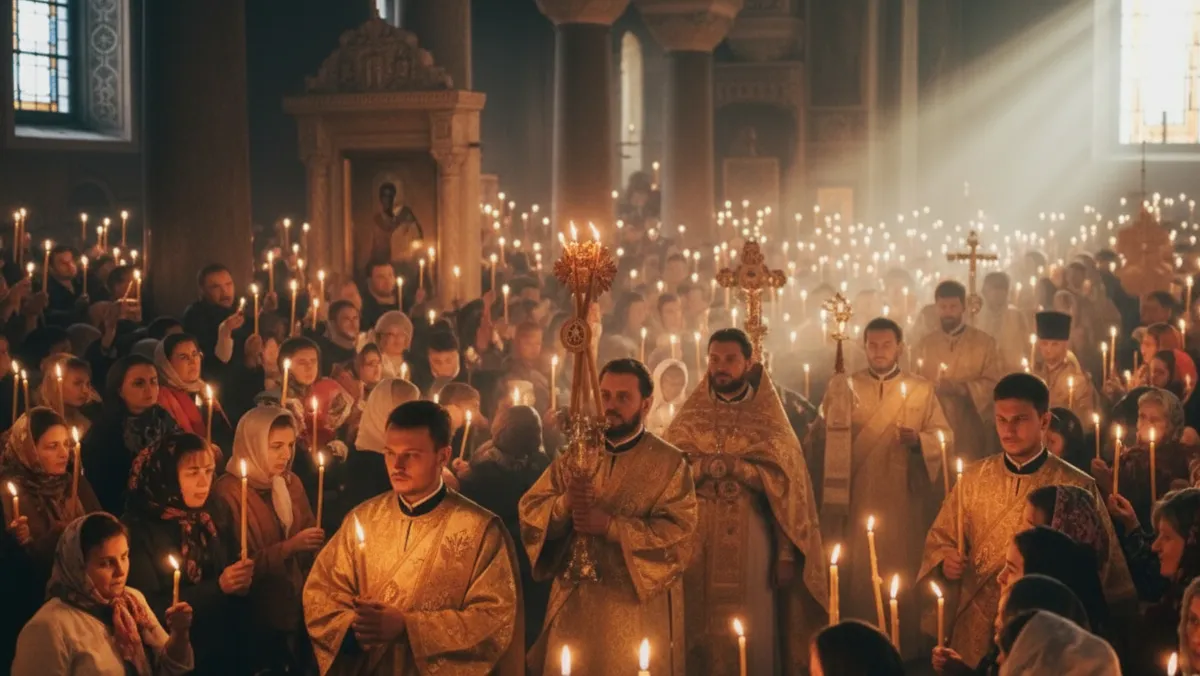
The central liturgical celebration of Orthodox Easter is a dramatic and beautiful service that begins in darkness and culminates in an explosion of light and joy. The celebration of Pascha begins with the Resurrection Service, a solemn procession and liturgy that starts late on Holy Saturday night in complete darkness and erupts into a joyous celebration of light and praise at the stroke of midnight.
This powerful service is a re-enactment of the disciples’ journey from sorrow to joy:
- Beginning in Darkness: The service begins in a dark, silent church, symbolizing the tomb and the despair of Christ’s death.
- The Procession: Shortly before midnight, the clergy and congregation process outside the church with unlit candles.
- The Proclamation: At midnight, the priest proclaims, “Christ is Risen!” and shares the light from his candle. The light is passed to everyone, the church bells ring joyously, and the congregation re-enters the now brightly lit church.
This transition from total darkness to brilliant light is a breathtaking and unforgettable experience. It’s like witnessing the very first sunrise after a long and starless night, its light instantly dispelling all fear and darkness. This powerful liturgy is the heart of the Orthodox Easter celebration.
4. The Paschal Greeting: “Christ is Risen!”
For the entire Paschal season (the 40 days following Easter), Orthodox Christians greet each other with a joyful and ancient proclamation of faith. Instead of a simple “hello,” Orthodox Christians greet one another with the Paschal greeting: “Christ is Risen!” to which the other responds, “Indeed, He is Risen!”
This greeting, used in many different languages, is a constant and joyful affirmation of the central truth of the faith.
- A Proclamation of Faith: It turns every greeting into a mini-sermon, a powerful declaration of the Resurrection.
- A Shared Joy: It reinforces a sense of communal joy and shared belief among the faithful.
- A Continuous Celebration: It ensures that the joy of Easter is not confined to a single day, but is celebrated for a full 40 days.
It’s like a secret, joyous password shared among members of a victorious army, a constant reminder of the great triumph they have all witnessed. This beautiful tradition keeps the reality of the Resurrection at the forefront of daily life.
5. Red Easter Eggs: A Symbol of Christ’s Blood and New Life
While eggs are a common Easter symbol, in the Orthodox tradition, they have a specific and powerful meaning. A central tradition in Orthodox Easter is the dyeing of hard-boiled eggs a deep, vibrant red, symbolizing the blood of Christ shed on the cross and the new life of the Resurrection that bursts forth from the tomb.
This symbolism is profound:
- Red for Christ’s Blood: The red color is a direct and powerful reminder of Christ’s life-giving sacrifice.
- The Egg for the Tomb: The egg itself symbolizes the sealed tomb of Christ.
- Cracking the Egg for the Resurrection: The cracking of the egg represents Christ breaking forth from the tomb in His resurrection.
Orthodox Christians often play a game where they tap their red eggs against each other. The person whose egg remains uncracked is said to have good luck for the year. This tradition beautifully combines profound theological symbolism with a joyful family activity. It’s like a small, beautiful object that holds the entire, powerful story of death and rebirth in its very form and color.
6. The Paschal Feast: A Joyous Celebration After the Fast
After the intense preparation of Great Lent, the celebration of Pascha culminates in a joyous and abundant feast. Following the midnight Resurrection Service, Orthodox families and communities break their long Lenten fast with a joyous Paschal feast, which often includes traditional foods that were abstained from during Lent, like lamb, cheese, and sweet breads.
This feast is a celebration of life and abundance:
- Breaking the Fast: It is a moment of great joy and relief, where foods that have been given up for 40 days are enjoyed once again.
- Traditional Foods: Many cultures have special Paschal foods, such as roasted lamb (symbolizing Christ, the Paschal Lamb) and a rich, sweet bread called Pascha or Tsoureki.
- Communal Joy: The feast is a time of hospitality, family, and communal celebration, often lasting for several days.
The transition from the strict fast to the abundant feast is a powerful, physical expression of the spiritual journey from the sorrow of Lent to the overwhelming joy of the Resurrection. It’s like a weary traveler, after a long and arduous journey through a barren desert, finally arriving at a magnificent, life-giving oasis.
7. The Art of Iconography: Windows to Heaven
While not exclusive to Easter, Orthodox iconography offers a unique and profound way of experiencing the Resurrection. Orthodox Easter is often experienced through the rich and symbolic art of iconography, particularly the icon of the “Harrowing of Hades,” which depicts Christ’s victorious descent into the realm of the dead to liberate Adam, Eve, and the righteous of the Old Testament.
This is the traditional Orthodox icon of the Resurrection. Instead of depicting Christ emerging from the tomb, it shows a more dynamic and theological event:
- Victory Over Death: Christ is shown standing on the shattered gates of Hades (the realm of the dead), a powerful symbol of his victory over death itself.
- Liberation of Humanity: He is forcefully pulling Adam and Eve from their tombs, symbolizing His salvation being extended to all of humanity, from the very first people.
- A Communal Resurrection: The icon often depicts other righteous figures (like David, Solomon, and John the Baptist) also being liberated, emphasizing the communal nature of salvation.
This powerful icon is a “window to heaven,” a theological statement in color and form that teaches the profound meaning of Christ’s victory. It’s like a stunning, cinematic poster that captures the most dramatic and significant moment of a great epic, revealing the hero’s ultimate triumph over the forces of darkness.
What Inspiration Will You Draw from These Timeless Traditions?
The exploration of Orthodox Easter reveals a rich and profound tapestry of ancient traditions, deep symbolism, and unwavering faith. From the intense preparation of Great Lent and the miraculous Holy Fire to the joyous midnight service and the powerful symbolism of red eggs and sacred icons, these practices offer a beautiful and inspiring vision of the Resurrection.
May this understanding deepen your appreciation for the diverse ways Christians celebrate our shared faith, and may it inspire you to embrace the joy and hope of Christ’s victory with a renewed sense of wonder and gratitude. Christ is Risen!
Now, your thoughts are welcome. The comments section is open!
→ Which of these 7 inspiring traditions of Orthodox Easter resonated most deeply with your spiritual understanding or surprised you the most?
→ How does the Orthodox tradition of a rigorous Lenten fast followed by a joyous feast impact your own view of spiritual discipline and celebration?
→ What’s one aspect of Orthodox Easter (e.g., the “Christ is Risen!” greeting, the symbolism of red eggs) that you feel could be beautifully incorporated into any Christian’s celebration of the Resurrection?
Sharing insights can encourage one another in our oracioncristiana.org community, as we celebrate the Risen Lord together!
