Oldest image of jesus: complete, essential guide with 5 key facts
oldest image of jesus: what we really know
The phrase oldest image of jesus sparks curiosity for good reason. Images shape how billions picture Jesus in their minds, from gentle shepherd to majestic ruler. But identifying the single oldest image of jesus is not as simple as pointing to one picture on a wall: it involves archaeology, art history, theology, and careful dating of fragile paintings and carvings. In this guide, we explore what counts as an “image”, where the earliest evidence comes from, and how scholars decide which depictions are truly ancient.
Rather than sensational claims, this article offers a clear, balanced tour of the evidence traditionally considered when people ask about the oldest image of jesus. We will look at Roman-era catacomb paintings, a remarkable house-church in Syria, a controversial piece of street graffiti, and the famous Sinai panel icon. You will discover why early Christians were cautious about images, how portrayals evolved across cultures, and where you can see early examples today.
What does “oldest image of jesus” really mean?
Before we choose a candidate, we must define terms. By “oldest image of jesus”, some people mean any depiction that refers to Christ, even if it is symbolic. Others insist on a recognisable portrait of Jesus performing a Biblical act. Both approaches matter, because the earliest Christians often chose symbols rather than faces.
Three distinctions help to frame the search for the oldest image of jesus:


- Symbolic versus figurative: A fish (ichthys), anchor, or chi-rho monogram is clearly Christian but not a portrait. A figure of a shepherd carrying a lamb can be a symbol for Christ without a specific facial likeness.
- Positive versus hostile: Not all ancient depictions were friendly. A mocking graffito might be earlier than a church fresco yet still “about” Jesus.
- Surviving versus original: We depend on what has physically survived. Ancient communities probably made images that have not endured; what we can study is what remains today.
Understanding these categories helps explain why different scholars nominate different examples for the oldest image of jesus, each with their own rationale.
Why early Christians were cautious with images
In the first centuries, Christians lived in a world shaped by Jewish Scripture and Roman social pressures. Judaism had strong aniconic tendencies—reserving images in worship was controversial—and early Christians inherited a careful approach to visual representation of the divine. There were also practical reasons: Christians often met in private homes or discreet spaces; public display of faith could attract suspicion. As a result, early art tends to be symbolic, narrative-focused, and pastoral rather than grand and public.
Only later, as the faith became tolerated and then imperial, did large public mosaics and icons flourish. This evolution affects what we can call the oldest image of jesus in a recognisable human form.
Candidates for the oldest image of jesus
Several artefacts are frequently discussed as contenders. Each offers a different angle on how early Christians—and their critics—portrayed Jesus.
The Alexamenos graffito: a mocking early reference
One famous contender is a piece of street graffiti known as the Alexamenos graffito, probably from the late second or early third century. Etched into a wall in Rome, it shows a human figure worshipping a crucified figure with a donkey’s head, alongside a Greek caption that roughly means “Alexamenos worships his god.” As a hostile caricature, it reflects how some pagans misunderstood Christian worship and the scandal of the cross. While not a devotional image, it is arguably among the earliest pictorial references to Jesus’ crucifixion. For context and images, see the overview on the Alexamenos graffito.
Does this count as the oldest image of jesus? If your criterion is “any ancient depiction referencing Christ,” then possibly. If you require a respectful or liturgical portrayal, you may prefer other candidates below.
Dura-Europos: a house-church with painted scenes
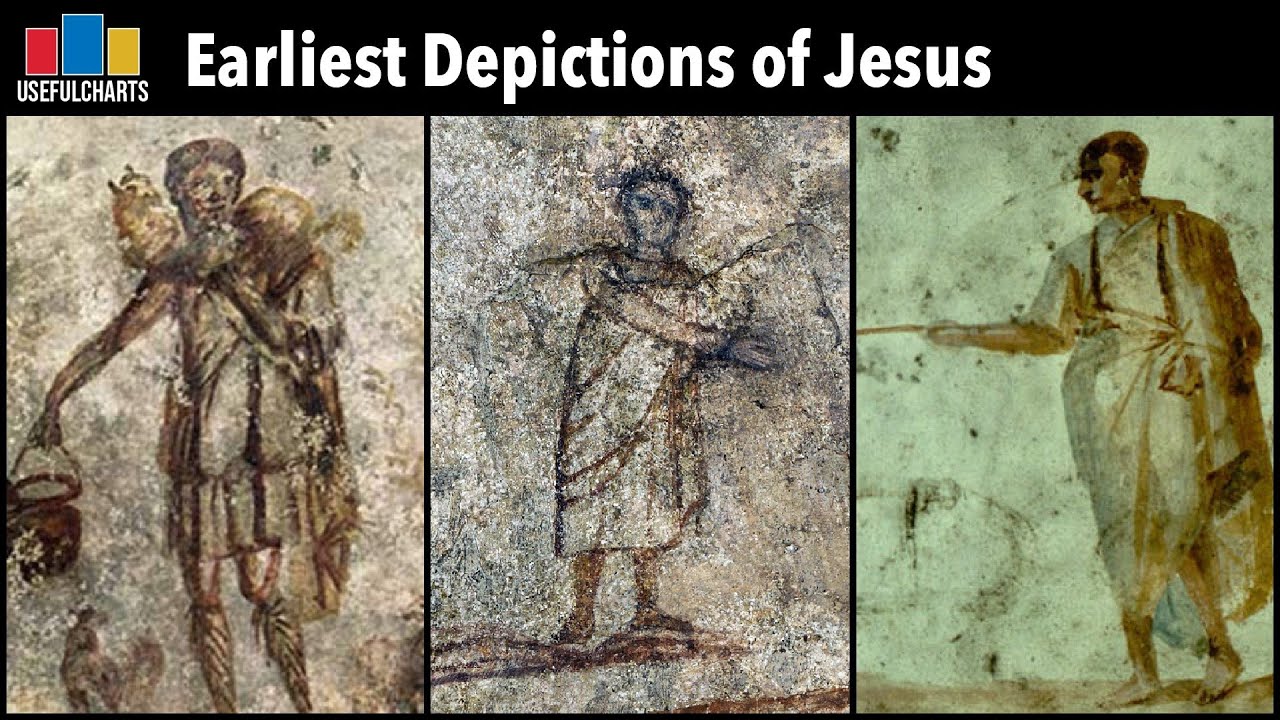
Another leading candidate for the oldest image of jesus in a Christian setting comes from the Dura-Europos church in Syria, dated to around AD 235. This small domestic church included a baptistery with painted biblical scenes. Two images are often highlighted: a Good Shepherd motif and a healing scene (frequently interpreted as Christ healing the paralytic). While the figures are stylised and not labelled with names, the narratives strongly suggest they refer to Christ. Learn more at the entry on the Dura-Europos Church.
These paintings matter because they come from an actual Christian worship space within a known archaeological context, strengthening their claim as candidates for the oldest image of jesus in situ.
Roman catacomb frescoes: the Good Shepherd and early narratives
In the Roman catacombs—subterranean burial sites used from the late second century onwards—painted images include the Good Shepherd, Jonah and the whale, and scenes interpreted as the raising of Lazarus or the Adoration of the Magi. The Good Shepherd appears widely in the Catacombs of Priscilla and the Catacombs of Domitilla, often dated to the third century. These scenes likely symbolise Christ’s care and salvation. A useful overview is on the Catacombs of Rome.
Do these constitute the oldest image of jesus? Again, much depends on definition. The Good Shepherd is sometimes a general pastoral motif; yet within Christian burial contexts, it commonly stands for Christ, nudging these frescoes firmly into the conversation.
Early sarcophagi reliefs
Carved Roman sarcophagi from the third and fourth centuries feature narrative panels such as the miracle at Cana, the multiplication of loaves, or the raising of Lazarus. While not portraits in our modern sense, these scenes present Jesus as a youthful philosopher-teacher, often beardless, in a style echoing Greco-Roman rhetorical imagery. They help illustrate how Christians moved from symbol to narrative, shaping the developing “look” of Jesus.
The Sinai icon: Christ Pantocrator
By the sixth century, we have the first substantially preserved panel paintings of Christ. The most celebrated is the Christ Pantocrator icon at Saint Catherine’s Monastery on Sinai. This icon, famous for its frontal gaze and asymmetric features, is not the oldest image of jesus, but it is among the earliest surviving panel portraits of Christ and arguably the single most influential image in later Christian art. See details at the Christ Pantocrator (Sinai) page.
How scholars date and verify the oldest image of jesus
Determining which artefact is truly the oldest image of jesus requires multiple lines of evidence. Specialists do not rely on style alone; they combine scientific tests, inscriptions, and archaeological context.
- Archaeological context: Excavation notes, sealed layers, and associated coins help fix dates. For instance, the Dura-Europos church was buried when the city fell in the mid-third century, giving its paintings a firm upper limit.
- Material analysis: Pigment composition (such as red ochre or Egyptian blue), plaster layers, and binding media offer clues about period and technique.
- Stylistic comparison: The way drapery folds, faces, and poses are rendered can align a piece with other datable works.
- Epigraphy and language: Inscriptions, if present, can assist with dating and identification.
- Historical documentation: Early travelogues, pilgrims’ accounts, or monastery catalogues sometimes record artworks, though such texts must be weighed carefully.
This careful method is why experts speak in ranges and probabilities. It also explains disagreements: a piece may be early third century by one estimate and late third by another, yet both remain important in the story of the oldest image of jesus.
What did the earliest images of Jesus look like?
In the third and fourth centuries, Jesus often appears as a beardless, youthful teacher—more philosopher than monarch. He may hold a scroll or gesture as if teaching. The Good Shepherd is popular: a lithe figure carrying a lamb across his shoulders, set amid simple pastoral scenes. Such images emphasise care, guidance, and salvation—themes suited to tombs and baptisteries.
By late antiquity and the Byzantine era, the image stabilises into a bearded Christ with long hair, often enthroned or blessing, known as Christ Pantocrator (“Ruler of All”). This shift reflects theological developments about Christ’s divinity and universal kingship. While this later icon type is not the oldest image of jesus, its visual DNA shapes how many today imagine Christ’s face.
Symbol or portrait? The tension at the heart of early images
Part of the fascination with the oldest image of jesus lies in how early Christians balanced symbol and portrait. Symbols like the fish or anchor were discreet and uncontroversial. Narrative scenes taught faith through story. Portrait-like images raised deeper questions: how to portray the invisible God made visible in Christ? Over centuries, Christian communities developed visual conventions that honoured Christ’s humanity and divinity without slipping into idolatry.
Cultural diversity in early portrayals
Christianity spread through Greek, Latin, Coptic, Syriac, and later Armenian and Ethiopian cultures. Each brought its artistic vocabulary. As a result, early “Jesuses” vary in complexion, dress, and emphasis. Some images stress Jesus as teacher, others as wonder-worker, shepherd, or cosmic ruler. This variety complicates any tidy answer to which exact piece is the oldest image of jesus; yet it enriches our understanding of how communities expressed faith visually.
These differences also reflect how Christian traditions developed. For a broader sense of how Eastern and Western branches diverged in practice and emphasis—affecting art and icon usage—see this accessible overview of Orthodox vs Catholic traditions.
Common misconceptions about the oldest image of jesus
Because this topic intersects with faith and identity, it attracts bold claims. Here are frequent misconceptions to approach with care:
- There is a definitive, single “first” portrait. Reality is messier. Several early candidates exist, each with a different claim (satirical versus devotional; symbolic versus narrative).
- Early Christians banned images entirely. While some groups were cautious or opposed, others used images—especially symbols and narratives—quite early, as catacombs and Dura-Europos show.
- The earliest images looked exactly like later icons. In fact, portrayals evolved markedly, from youthful philosopher to bearded Pantocrator.
- Every sensational “discovery” is reliable. Robust dating and provenance are essential; extraordinary claims require strong evidence.
How image-making relates to worship and festivals
Images do not exist in a vacuum; they accompany worship, teaching, and celebration. Baptistery scenes in Dura-Europos suggest catechesis and initiation. Catacomb art speaks to hope in resurrection. As the church’s calendar formed, images proliferated in churches and public spaces to instruct and inspire. Questions about the origin of Christian festivals sometimes spill into debates on imagery and “borrowed” symbols. For a clear explainer on a related topic, see this discussion: Is Easter pagan? historical background and Christian meaning.
Where to see early images today
To explore candidates for the oldest image of jesus, start with sites and collections that preserve third- to sixth-century works. The Roman catacombs offer guided visits and reproductions. The archaeological site of Dura-Europos is best approached through museum collections and scholarly summaries. For early icons, Saint Catherine’s Monastery remains a landmark, with reproductions and studies available through reputable institutions.
Good overviews include introductory essays and museum guides. For instance, the Metropolitan Museum of Art’s timeline offers a primer on early Christian imagery; the British and European collections include late antique examples, and accessible encyclopaedias summarise key debates. See, for example, the Met’s essay on Early Christian Art, the entry on the Dura-Europos Church, a guide to the Roman catacombs, and a focused discussion of the Sinai Christ Pantocrator icon.
Recommended external resources
- Metropolitan Museum of Art: Early Christian Art overview
- Dura-Europos Church: early Christian house-church and paintings
- Catacombs of Rome: contexts for early Christian frescoes
- Alexamenos graffito: an early (hostile) depiction linked to Christ
Related articles
Frequently asked questions about oldest image of jesus
What is generally considered the oldest image of Jesus?
There is no single uncontested example. The hostile Alexamenos graffito (late second/early third century) is an early pictorial reference to Christ’s crucifixion. Among devotional contexts, the Dura-Europos church paintings (around AD 235) and third-century catacomb frescoes are top candidates. Each meets a slightly different definition of the oldest image of jesus.
Why do many early depictions show a “Good Shepherd” rather than a bearded Christ?
The Good Shepherd symbolised care, sacrifice, and salvation—ideal themes for tombs and baptisteries. In the Roman world, pastoral imagery was familiar and discreet. Over time, as theological reflection deepened and public worship expanded, more explicitly Christ-like portraits emerged.
Did early Christians avoid images altogether?
Not entirely. Some groups were cautious, but evidence from catacombs, house-churches, and sarcophagi shows that images—especially symbolic and narrative ones—were used within Christian contexts. The energetic debates about images came to the fore later, particularly in the Byzantine iconoclasm controversies.
Is the Shroud of Turin the oldest image of Jesus?
The Shroud is a devotional object with a complex history and ongoing debate. It is not generally listed among the earliest painted or carved depictions used in worship spaces. When discussing the oldest image of jesus in art-historical terms, scholars usually point to third-century frescoes and reliefs.
How do experts authenticate an early image of Jesus?
They combine context (where it was found), material analysis (pigments, plaster), stylistic comparison, epigraphy, and historical records. No single test suffices; rather, a suite of evidence builds a reliable date range and identification.
Where can I see the earliest images today?
In Rome’s catacombs (with guided access), in museum collections that hold late antique artefacts, and in publications about Dura-Europos and Saint Catherine’s Monastery on Sinai. If travel is not possible, many institutions provide high-quality online galleries and essays.
Why do early images sometimes show a beardless Jesus?
Early artists borrowed visual languages familiar from Greco-Roman culture. Portraying Jesus as a youthful philosopher-teacher made sense in that context. The bearded Pantocrator type became dominant later.
Conclusion on oldest image of jesus
When we ask about the oldest image of jesus, we are really asking several questions at once: do we mean the earliest reference, the earliest respectful portrayal, or the earliest image in a church context? A mocking street graffito, a house-church fresco, and a catacomb Good Shepherd each provide honest but different answers. Rather than insisting on a single “first”, it is better to see how these pieces together chart a path from symbol to story to portrait.
The earliest images show Christ as shepherd, healer, and teacher—figures that comforted the bereaved and instructed new believers. Later, the bearded Pantocrator embodied Christ’s universal rule. This development reflects the church’s journey from private homes to public basilicas, and from cautious signs to confident visual theology.
With careful methods of dating and interpretation, scholars keep refining our understanding of the oldest image of jesus. You can explore this story for yourself by visiting catacombs, reading museum essays, and comparing early examples across cultures. However you approach it, these images are not curiosities; they are windows into how the first Christians learned to picture hope, mercy, and the face of the one they worshipped.
Ultimately, the oldest image of jesus is less a single artefact than a family of early witnesses. Together, they reveal how faith took artistic form—quietly at first, then with growing clarity—leaving a legacy that still shapes how we imagine Jesus today.
