Is Jesus Black? 5 Surprising Facts You Need to Know

Respuesta Rápida
¿Is Jesus Black? Yes and no, depending on the context. Historically and physically, Jesus was a first-century Middle Eastern Jew, meaning he almost certainly had brown skin, dark eyes, and dark hair, similar to modern Middle Eastern or North African populations.
Here is the breakdown of the different “images” of Jesus:
- The Historical Jesus: A Semitic man from Galilee.
- The European Jesus: The common image of a white, often blue-eyed man, is an artistic representation that originated in European Renaissance art.
- The Black Jesus: This is a crucial theological concept in Black Liberation Theology, stating that Christ identifies completely with the oppressed; therefore, in a racist society, Jesus is spiritually and solidarity-wise “Black.”
Let’s talk about the big picture—maybe the biggest picture in all of Western history. When you close your eyes and picture “Jesus,” what do you see?
For most of us, especially in the West, the image is instant. It’s the one from countless paintings, stained-glass windows, and movies: a tall man with fair skin, long, flowing light-brown hair, and often, blue eyes. This is the Jesus many of us grew up with.
But in recent years, a crucial question has challenged this image: “Is Jesus Black?”

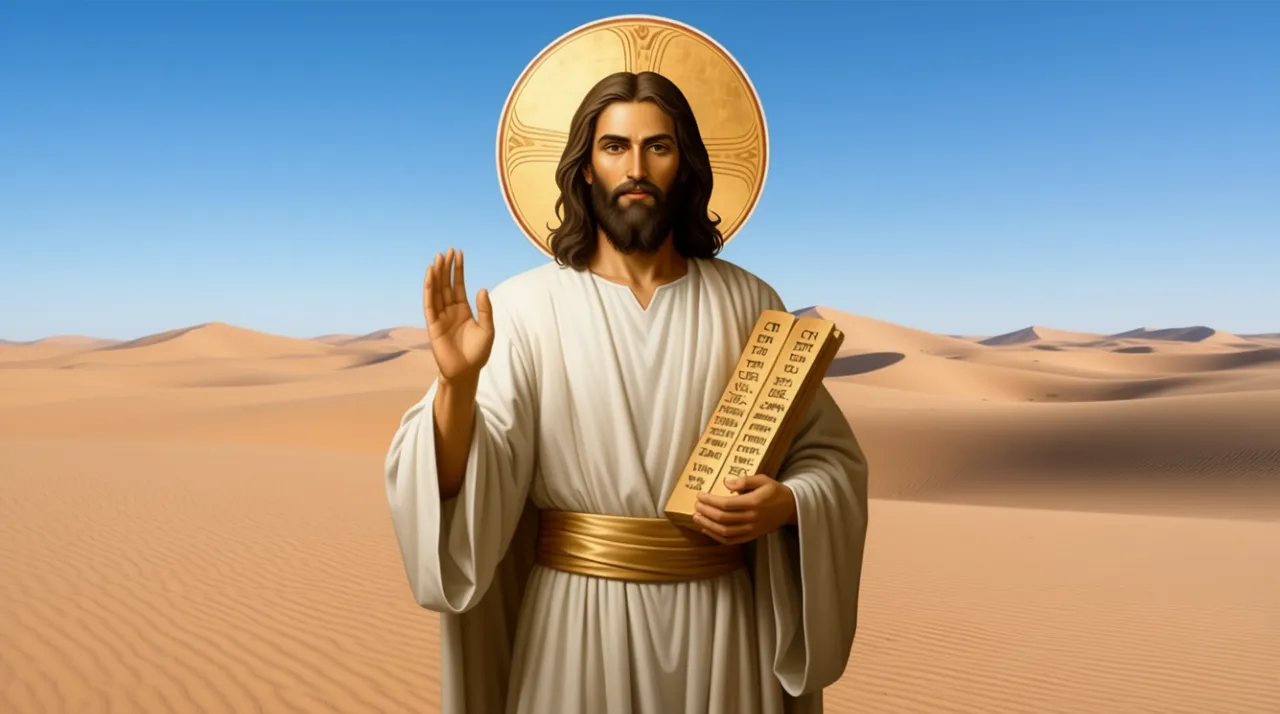
This question isn’t just about skin color. It’s a deep, powerful question that cuts to the heart of history, art, theology, and how we identify with God. It asks us to separate the historical man from the cultural icon and to understand why that difference matters so deeply to our faith.
So, let’s tackle this important conversation with honesty and clarity. As a community of faith here at oracioncristiana.org, we aren’t afraid of tough questions. The truth only deepens our relationship with Christ. Let’s dive into the 5 surprising facts you need to know about the race, ethnicity, and true identity of Jesus.
1. The Historical Answer: Jesus Was a First-Century Middle Eastern Jew
Before we can talk about art or theology, we have to start with history. The single most accurate historical description of Jesus is that he was a first-century Middle Eastern Jew.
This is not a theory; it’s a historical fact. Jesus was born in Bethlehem (a town in Judea) to a Jewish mother, Mary. He was raised in Nazareth, a Jewish village in a region called Galilee. He was not European, he was not (in the modern sense) sub-Saharan African. He was a Semitic man, born and raised in the ancient Middle East under the occupation of the Roman Empire.
So, what does this mean for his appearance? Based on the genetics of the region and the time, we can be almost certain:
- He would have had dark brown to black hair.
- He would have had dark brown eyes.
- His skin tone would have been olive-brown or dark brown, consistent with other Semitic people from that region who spent their lives working outdoors in a desert climate.
The fair-skinned, blue-eyed image is historically impossible. The Bible itself never gives a physical description of Jesus, likely because the Gospel writers were infinitely more concerned with who he was (the Son of God) and what he taught, rather than what he looked like.
2. What Science Says: The Forensic Reconstruction of Jesus
If the Bible doesn’t describe him, how can we know what he looked like? Well, we have science. One of the most famous and credible attempts to answer this was led by Richard Neave, a retired medical artist and forensic scientist from the University of Manchester.
In 2001, for the BBC documentary “Son of God,” Neave’s team used the skulls of three first-century Semitic men found in Galilee—the very region where Jesus lived and worked. Using modern forensic anthropology, they created a reconstruction of what a “typical” Galilean man from that time would look like.
The results were stunning and very different from the Renaissance paintings:
- Height: The average man was about 5 feet 5 inches tall (not the tall, looming figure often depicted).
- Build: He was likely stocky and muscular, built like a laborer (he was a tekton, a craftsman/carpenter).
- Face: He had a broad Semitic face, a large nose, and likely, short, curly black hair and a beard, which was the traditional style for Jewish men of the time, following Jewish law.
- Skin: Dark olive to deep brown.
While this isn’t a “photograph” of Jesus, forensic scientists agree: this is infinitely more accurate than any European painting. This is the face of the people Jesus lived with, and it’s very likely what he looked like, too.
3. So, Why Is Jesus Pictured as White? (The History of Art)
This is the most common follow-up question. If he was a brown, Middle Eastern man, why is the most famous image of him a white, European man? The answer isn’t some grand conspiracy; it’s a very human process called “inculturation.”
Inculturation is the natural process of cultures portraying religious figures in their own image, to make them relatable. For centuries, every culture has done this.
The “white Jesus” image became dominant for one simple reason: for over 1,000 years, the global center of Christianity was Europe. During the Renaissance (1400s-1600s), European masters like Michelangelo, Caravaggio, and Leonardo da Vinci painted biblical scenes. When they needed a model for Jesus or the apostles, who did they use? The only people they knew: local Italian or Dutch men.
This image became the “default” because European nations, through colonization and missionary work, exported their art and their culture all over the world. But this wasn’t the only image. It just happened to be the one created by the most globally dominant culture.
Jesus in Other Cultures
The truth is, Europeans aren’t the only ones who did this. Go anywhere in the world, and you will see Jesus portrayed in the image of the local people. This isn’t heresy; it’s a beautiful testament to the universality of Christ’s message.
| Culture | Common Artistic Depiction of Jesus |
|---|---|
| Korean Christianity | Often depicted with Korean features, wearing a traditional Korean hanbok (robe). |
| Ethiopian Orthodoxy | Jesus and Mary are consistently depicted as Black, with dark skin and African features, in their ancient and iconic art style. |
| Peruvian Catholicism | Jesus is often shown as a dark-skinned Latino or Indigenous man (e.g., El Señor de los Milagros, “The Lord of Miracles”). |
| European Renaissance | Depicted as a white European, often with fair skin and light brown or even blonde hair. |
Viewing a Korean Jesus or an Ethiopian Jesus doesn’t mean they think Jesus was ethnically Korean or Ethiopian. It’s a theological statement: “Jesus is for us. He is with us. He understands our life and our people.”
4. The “Black Jesus”: A Powerful Theological Truth
This brings us to the core of the question: “Is Jesus Black?” As we’ve seen, historically, he was Middle Eastern, not sub-Saharan African. But the term “Black Jesus” is one of the most powerful theological declarations of the last century.
This concept is the heart of Black Liberation Theology, a movement pioneered by theologians like Dr. James Cone. In his groundbreaking 1969 book, Black Theology & Black Power, Cone made a radical argument that shook Christianity.
Here is the logic:
- The God of the Bible (Yahweh) is a God who reveals Himself by liberating the oppressed (like the Israelites from slavery in Egypt).
- Jesus’s ministry on Earth was focused on the “least of these”—the poor, the sick, the outcast, the sinner. He was a colonized Jew, executed by the oppressive Roman state.
- Therefore, if God stands with the oppressed, in 20th and 21st-century America (and other nations with a legacy of slavery and racism), who are the oppressed? It is the Black community.
So, when a theologian says “Jesus is Black,” they are not making a claim about his first-century ethnicity. They are making a profound theological claim about his present-day identity and solidarity. It means Christ is not a neutral, distant deity; he is physically and spiritually present with those who are suffering, marginalized, and oppressed. In a racist society, Jesus stands with the victims of that racism. Therefore, “Jesus is Black.”
As NPR notes, this idea gave millions of people a way to connect with a God who wasn’t the “white God of the oppressor,” but a “Black God of liberation.”
5. Does His Ethnicity Really Matter to Our Faith?
This is the final question, the one we ask at oracioncristiana.org. Okay, he was historically brown, artistically white, and theologically Black. Does any of this actually matter, or is it just identity politics? Can’t we just say his soul is what matters?
The answer is yes, it matters profoundly, for two key reasons.
It Affirms the Incarnation
Our faith is built on one impossible, essential belief: the Incarnation. That God didn’t just send a message; He became human. He became a real man. To be a real man, you must be born in a real place, at a real time, to a real mother, with a real ethnicity.
Insisting on the “historical Jesus”—the 5’5”, brown-skinned, Aramaic-speaking Galilean craftsman—is an affirmation of our faith! It saves him from being a generic, floating fairy-tale myth. He was real. He got tired, he got hungry, he had a specific human body, and that body was a Middle Eastern one. This makes his life, death, and resurrection more real, not less.
It Separates the Gospel from Colonialism
For centuries, the image of a “White Jesus” was used not just for art, but as a tool of oppression and cultural imperialism. It was used to send a devastating message: that God was white, and that to be “saved” or “civilized,” one had to adopt the culture and norms of white Europe.
Recognizing that Jesus was a brown-skinned, colonized Jew from a poor village completely flips that narrative. It reminds us that Jesus was not on the side of the Empire, the rich, or the powerful. He was one of the oppressed. His message is inherently a threat to empires, not a tool for them.
Ultimately, Christ’s identity is universal. As the Apostle Paul wrote, in Christ “there is neither Jew nor Gentile, neither slave nor free, nor is there male and female” (Galatians 3:28). But he achieves this universality not by being a blank, colorless slate, but by being born into a specific, marginalized people, living their struggle, and offering a salvation that is for all people.
What Does Your Image of Jesus Look Like?
This is a big conversation, and it’s an important one. Our mental picture of God matters. Challenging our old, inherited images isn’t an act of disrespect; it’s an act of spiritual maturity. It allows us to get closer to the real, historical man who walked the dusty roads of Galilee and to embrace the radical, universal, and liberating God he came to reveal.
Now, I really want to hear from you. The comments section is open!
→ Did you grow up with the “white Jesus” image? How do you feel about it now?
→ How does picturing Jesus as a 1st-century Middle Eastern man change how you read the Gospels?
→ What does the theological idea of a “Black Jesus” mean to you in your faith walk?
Let’s discuss this with openness and respect!
