Hail Mary Holy Queen Prayer: Essential, Practical Guide (5 Steps)
hail mary holy queen prayer
The hail mary holy queen prayer is a central part of Catholic devotion, uniting two of the best-known Marian prayers: the Hail Mary (Ave Maria) and the Hail Holy Queen (Salve Regina). Together, they form a gentle yet rich pathway into Christian meditation, trust, and hope. Whether you are new to these prayers or returning after years away, this guide will help you understand their origins, meaning, and how to pray them with confidence.
In everyday practice, Catholics say the Hail Mary repeatedly within the Rosary and conclude the Rosary with the Holy Queen. Beyond the Rosary, both prayers stand well on their own in private devotion and in community worship. This article explains what the hail mary holy queen prayer is, why it matters, how to pray it, and what to avoid, with clear tips for beginners and useful insights for anyone wishing to deepen their spirituality.
What is the hail mary holy queen prayer?
Strictly speaking, the phrase hail mary holy queen prayer refers to two distinct prayers that are often prayed together as part of the Rosary or night prayer (Compline) in the Liturgy of the Hours. The Hail Mary draws its first half from Scripture, combining the Angel Gabriel’s greeting to Mary (Luke 1:28) and Elizabeth’s words (Luke 1:42). The Hail Holy Queen, known in Latin as the Salve Regina, is a separate, ancient hymn addressing Mary as our merciful advocate and mother, concluding many Catholic devotions.
In everyday language, people sometimes use hail mary holy queen prayer to mean “the Marian prayers said in the Rosary.” In that setting, the Hail Mary is repeated on each decade, while the Hail Holy Queen is prayed at the end, bringing the devotion to a peaceful close.


A brief history and origins
Origins of the Hail Mary
The Hail Mary developed from Scripture and early Christian devotion. Its first half is straight from the Gospels, while the second half, beginning “Holy Mary, Mother of God,” was shaped by centuries of the Church’s prayer and reflection on Christ and his mother. By the late Middle Ages, the prayer had settled into the familiar wording still used today in English-speaking contexts.
Origins of the Hail Holy Queen (Salve Regina)
The Hail Holy Queen is a Latin hymn from the 11th or 12th century, commonly attributed to Blessed Hermann of Reichenau. Long cherished in Western Christianity, it became a standard conclusion to the Rosary and a key part of the Church’s liturgy, especially at Compline. Its language is tender and trusting, portraying Mary as a compassionate mother who leads her children to Christ.
Transmission and translation
Both prayers spread widely through monastic life, parish worship, and popular devotion. Translators over time produced English versions that balance accuracy, beauty, and singability. The Church allows minor variations across regions, but the essence remains: praise of God for the Incarnation, honour for Mary’s unique role, and a request for her intercession. In this sense, the hail mary holy queen prayer is both historical and living—handed down, yet freshly prayed in every generation.
The words and their meaning
The Hail Mary: text and sense
“Hail Mary, full of grace, the Lord is with thee; blessed art thou among women, and blessed is the fruit of thy womb, Jesus.
Holy Mary, Mother of God, pray for us sinners, now and at the hour of our death. Amen.”
The first lines echo Scripture, praising God’s action in Mary’s life. To call her “full of grace” and “blessed” is to recognise what God has done. The second part asks for Mary’s prayers—intercession—for us at every moment, especially at life’s end. Far from replacing prayer to God, the Hail Mary leads us to Jesus through the one who first said yes to him.
The Hail Holy Queen (Salve Regina): text and sense
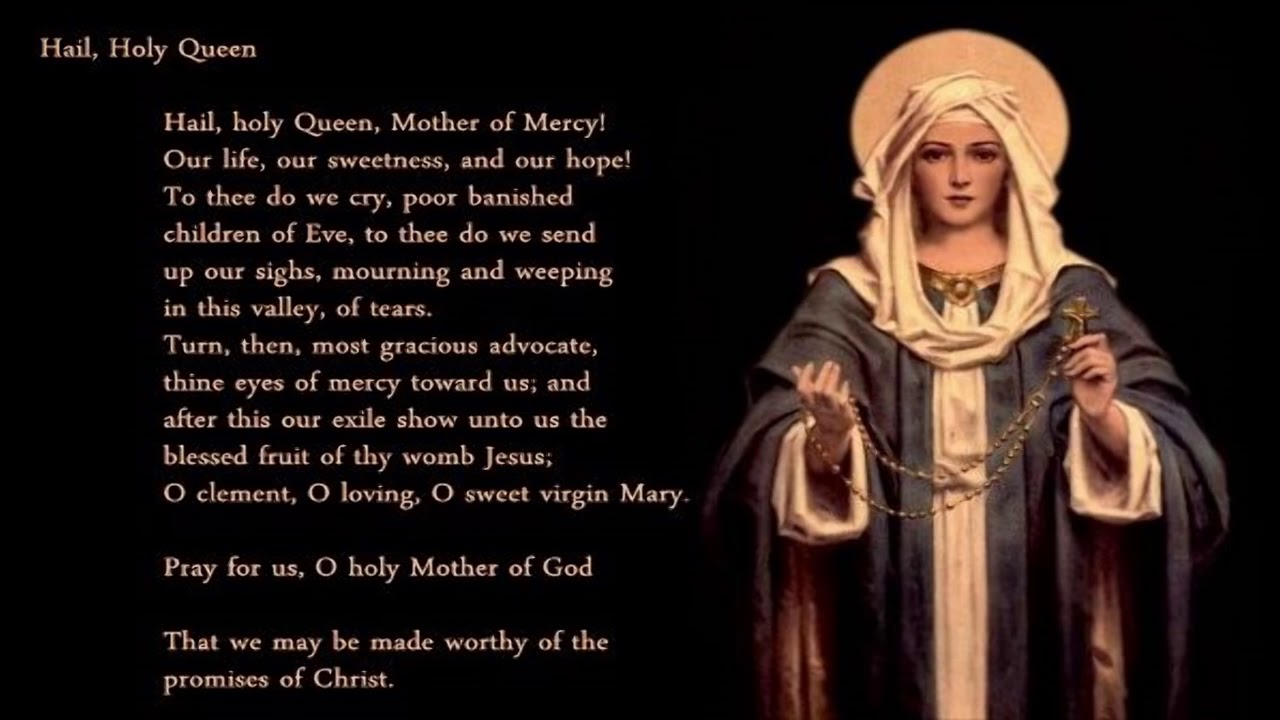
“Hail, holy Queen, Mother of mercy, our life, our sweetness, and our hope. To thee do we cry, poor banished children of Eve; to thee do we send up our sighs, mourning and weeping in this vale of tears.
Turn then, most gracious advocate, thine eyes of mercy toward us; and after this our exile show unto us the blessed fruit of thy womb, Jesus. O clement, O loving, O sweet Virgin Mary.”
This hymn acknowledges life’s trials and places our hope in Christ, asking Mary, the mother of mercy, to guide us towards him. When people speak of the hail mary holy queen prayer, they often mean this pairing of personal need and trust—expressed in words that are simple, memorable, and consoling.
How to pray the hail mary holy queen prayer in practice
Praying within the Rosary
The Rosary is a meditative prayer focused on the life of Jesus, seen through the eyes of Mary. The Hail Mary forms the heartbeat of the decades, while the Hail Holy Queen concludes the whole devotion. A straightforward way to get started is to set aside 15–20 minutes, choose one set of mysteries (Joyful, Sorrowful, Glorious, or Luminous), and proceed calmly.
- Begin with the Sign of the Cross.
- On the crucifix, pray the Apostles’ Creed; then an Our Father on the next large bead.
- Pray three Hail Marys (for faith, hope, and charity), then a Glory Be.
- Announce the first mystery and, on each small bead, pray a Hail Mary while reflecting on that mystery.
- After each decade, pray the Glory Be. Many also add the Fatima Prayer.
- After five decades, pray the Hail Holy Queen, sometimes followed by a concluding prayer.
When you finish the fifth decade, the Hail Holy Queen brings your intentions and reflections together. In this structured rhythm, the hail mary holy queen prayer becomes a gentle guide to a deeper encounter with Christ.
Praying on its own
Both prayers are beautiful on their own. You might pray a single Hail Mary while pausing before a meeting, or pray the Hail Holy Queen before bed. Some like to pray them together at night: three Hail Marys as a short examen and the Hail Holy Queen as a peaceful surrender into God’s mercy. Over time, this regular practise builds a habit of awareness and trust.
Key themes and theology
Christ at the centre
Neither prayer stops at Mary; both lead to Jesus. The Hail Mary literally names him at the centre of the prayer. The Hail Holy Queen asks Mary to show us the “blessed fruit” of her womb—Christ. Properly understood, the hail mary holy queen prayer is entirely Christocentric, honouring Mary for the sake of her Son and our salvation in him.
Intercession and the communion of saints
Asking Mary to “pray for us” flows from the Christian belief that in Christ, life and love are stronger than death. The saints, alive in him, pray for the Church on earth. Mary, as Theotokos (Mother of God), has a special place; her intercession is not a barrier to God but a humble request that she, close to Christ, join her prayer to ours.
Mercy, hope, and discipleship
The Hail Holy Queen’s language is tender: “Mother of mercy,” “our hope,” and “most gracious advocate.” This does not replace Christ the Mediator but celebrates how God’s mercy reaches us in family-like ways. Praying the hail mary holy queen prayer can foster hope during grief, courage in struggle, and a steady desire to follow Jesus more closely.
Benefits and spiritual fruits
- Calm and focus: The steady rhythm helps quiet the mind.
- Scriptural meditation: The Hail Mary’s first half is directly biblical, anchoring your prayer in the Gospel.
- Perseverance: Repetition is not empty; it trains the heart in fidelity, like breathing exercises for the soul.
- Community: Around the world, millions pray these words; joining them can be deeply reassuring.
- Hope: The Hail Holy Queen’s compassionate tone is especially consoling in times of uncertainty.
Practical tips for beginners
- Start small: One decade with a calm Hail Holy Queen at the end is a great beginning.
- Choose a time: Morning or evening often works best; consistency matters more than length.
- Use a guide: A simple leaflet or app for the Rosary can help you follow along without distraction.
- Breathe: Slow your pace. Let each phrase of the hail mary holy queen prayer sink in.
- Bring intentions: Offer your prayer for someone in need, a difficult decision, or gratitude.
Common mistakes and how to avoid them
Rushing through the words
It is easy to hurry, especially in groups. Slow down. The point is not to “get through” the hail mary holy queen prayer but to pray it. Silence between decades can be helpful.
Forgetting the mysteries
When praying the Rosary, the Hail Marys support meditation on Christ’s life. If your mind wanders, gently return to the scene: the Annunciation, the Crucifixion, the Resurrection, or others. The words are the walkway; the mysteries are the view.
Overcomplicating the method
There are beautiful variations and added prayers, but do not feel obliged to learn everything at once. Keep the hail mary holy queen prayer simple at first. As you gain confidence, you can explore more.
Ecumenical and cultural perspectives
Christians differ in how they understand and practise devotion to Mary. Many Catholics and some Anglicans regularly pray the Rosary and the Salve Regina, while many Protestants prefer to speak directly to God without the language of intercession. Orthodox Christians honour Mary profoundly, though their public devotions take different forms. For a balanced overview of traditions, see this helpful comparison of major Christian traditions: Orthodox vs Catholic. Whichever your background, approaching the hail mary holy queen prayer with respect can foster deeper understanding across communities.
Using the hail mary holy queen prayer alongside other devotions
Many find that pairing the Rosary with occasional chaplets or short litanies gives rhythm to the week. For example, on Fridays you might pray the Rosary and, on Sundays, the Divine Mercy Chaplet. If you are curious, you can learn a straightforward and meaningful devotion here: Divine Mercy Chaplet prayer. Complementary practices like these can enrich your spiritual life without overwhelming it.
Examples of when to pray
- Before or after Mass, as a quiet preparation or thanksgiving.
- On a commute or walk, with beads or simply counting on your fingers.
- During difficult seasons: illness, grief, or anxiety—when words are hard to find, the hail mary holy queen prayer can hold you steady.
- As a family practice, perhaps one decade a day, allowing children to grow into the rhythm.
Recommended external resources
- USCCB guide to the Holy Rosary, including the Hail Mary and Hail Holy Queen
- Background and variations on the Hail Mary (Wikipedia)
- History and text of the Salve Regina (Hail Holy Queen) (Wikipedia)
- Vatican II’s Lumen Gentium, Chapter VIII on the Blessed Virgin Mary
Related articles
- Differences and similarities between Orthodox and Catholic traditions
- How to pray the Divine Mercy Chaplet
Frequently asked questions about hail mary holy queen prayer
Are the Hail Mary and the Hail Holy Queen the same prayer?
No. The Hail Mary is largely scriptural and is repeated throughout the Rosary; the Hail Holy Queen (Salve Regina) is a separate hymn traditionally prayed at the end. When people say “hail mary holy queen prayer,” they usually mean these two prayers said together in the Rosary or in personal devotion.
Is the hail mary holy queen prayer biblical?
The first half of the Hail Mary comes directly from the Bible (Luke 1:28 and 1:42). The second half and the Hail Holy Queen are not quoted from Scripture but reflect biblical truths about Christ, mercy, and intercession. Together, they form a prayerful meditation grounded in the Gospel.
Do I need rosary beads to pray?
Beads are helpful but not essential. You can pray a decade using your fingers or a simple tally. What matters is a sincere heart and steady attention. If beads help you slow down, by all means use them; if not, keep the hail mary holy queen prayer simple.
Can non-Catholics pray the hail mary holy queen prayer?
Yes. Many Christians outside the Catholic Church appreciate the beauty and biblical roots of these prayers. If you are not Catholic but wish to pray them, feel free. Focus on Christ and ask Mary to lead you closer to him.
When should I pray the Hail Holy Queen?
Traditionally, it concludes the Rosary and is also used in night prayer (Compline). Privately, you can pray it whenever you want to entrust your concerns to God’s mercy. A quiet evening moment works well for many people.
How often should I say the hail mary holy queen prayer?
There is no fixed rule. Some pray daily; others turn to it in particular need. Start where you are—perhaps one decade and the Hail Holy Queen a few times a week—and adjust as your schedule allows.
What if I find repetition difficult?
Repetition in prayer is not meant to bore you but to settle the mind so the heart can listen. If you become restless, try praying more slowly, meditating on a single phrase, or shortening your time. Over days and weeks, the gentle cadence of the hail mary holy queen prayer often becomes reassuring rather than tedious.
Conclusion on hail mary holy queen prayer
The hail mary holy queen prayer blends Scripture, tradition, and heartfelt petition into a pathway of peace. The Hail Mary draws us into the mystery of the Incarnation and the joy of Elizabeth’s blessing; the Hail Holy Queen teaches us to trust in mercy and to look to Christ as our hope. Prayed together, they form a simple, profound school of prayer for everyday life.
If you are just beginning, start small—one decade and the Hail Holy Queen—and let the habit grow. If you are returning after a while away, allow the familiar words to carry you. Whether prayed alone or with others, the hail mary holy queen prayer can steady the mind, console the heart, and point, always, to Jesus.
Across centuries and cultures, these prayers have helped countless people practise faith with humility and courage. May they help you, too, to find stillness, to persevere, and to hope—today and every day.
