Earliest known picture of Jesus: 5 key facts, essential guide
earliest known picture of jesus
The phrase earliest known picture of jesus sparks fascination because it bridges faith, history, and archaeology. People want to know whether any actual portrait of Jesus survives, where it comes from, and what it tells us about the earliest Christians. This search matters: the images we accept as “early” influence how we imagine Jesus, how we understand Christian art, and how we interpret the spread of Christianity across the Roman world. In what follows, we look at what scholars currently consider the most credible candidates for the earliest known picture of jesus, how experts date and authenticate such images, and how the portrayal of Jesus evolved from symbolic motifs to recognisable portraits.
There is no single, universally agreed-upon answer. Instead, a small set of third-century images—some devotional, some narrative—have the strongest claim to be the earliest known picture of jesus. We will also distinguish images created by Christians from hostile or satirical depictions, and we will explain how archaeologists decide which images are genuinely early and which are later copies, misinterpretations, or myths.
What do we mean by the earliest known picture of Jesus?
Before naming examples, it helps to define terms. The “earliest known picture of Jesus” could mean several things. It might refer to the oldest surviving image made by Christians for devotion, the oldest narrative scene that includes Jesus (for example, a miracle), or the earliest depiction referencing Jesus at all, even if created by non-Christians. It could also be either a symbolic representation—such as the Good Shepherd—or a more literal image showing a human figure identified as Jesus.
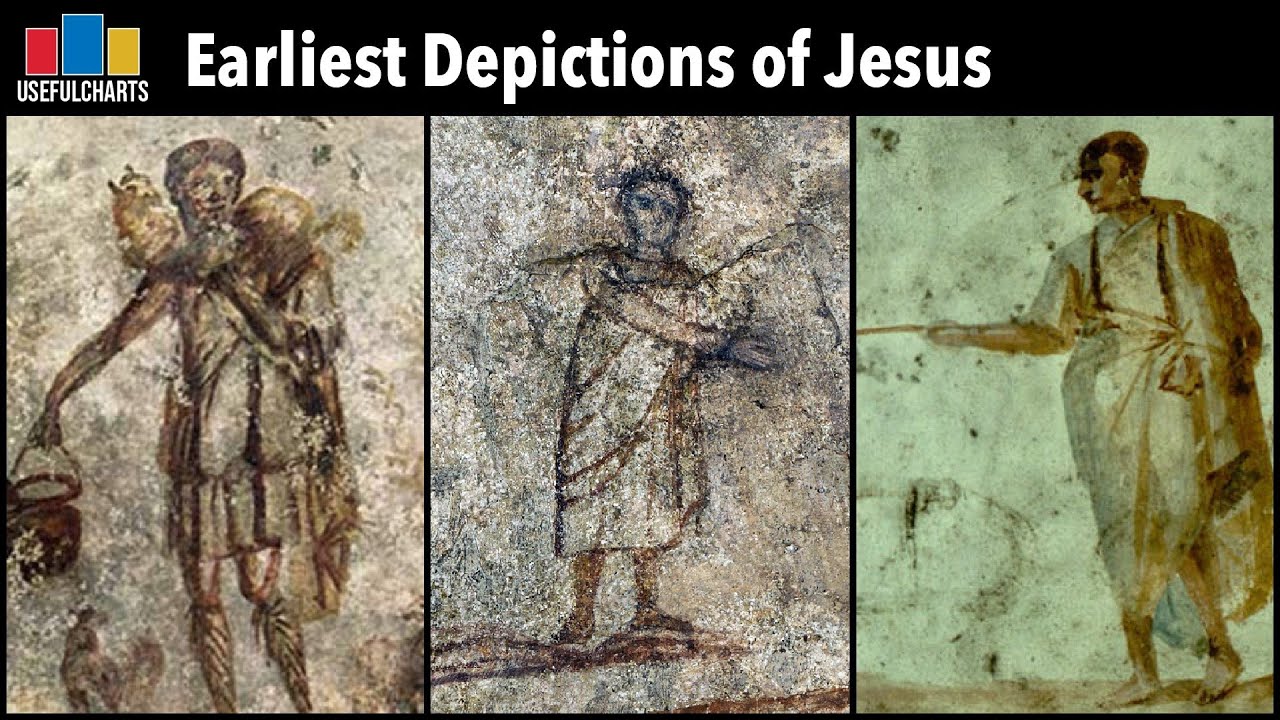
Early Christian art often preferred symbolism. In the third century, Jesus frequently appears as the Good Shepherd—a youthful, clean-shaven figure carrying a lamb—rather than as a detailed portrait. That motif merges biblical imagery with Roman visual language. If we take symbolism into account, the earliest known picture of jesus may be a shepherd scene in the Roman catacombs. If we insist on a named, narrative scene, the Dura-Europos house church offers some of the most important candidates from around the mid-third century.


Where archaeology points today
Dura-Europos and the earliest house church frescoes (c. AD 235)
One of the strongest contenders for the earliest known picture of jesus is found in the house church at Dura-Europos, a frontier city on the Euphrates. Excavations revealed a domestic building converted for Christian worship, including a baptistry decorated with wall paintings. Among these frescoes are scenes interpreted as the Healing of the Paralytic and Jesus Walking on Water. These are narrative images in which Jesus appears as an identifiable protagonist. The dating (around AD 235) is based on secure archaeological context and has stood up to scholarly scrutiny. You can find a concise overview in the article on the site’s Christian building at Dura-Europos church (Wikipedia), and an institutional summary of the site and collections in the Yale University Art Gallery’s Dura-Europos resource.
These Dura frescoes are important because they are not simply symbols; they tell a story with Jesus as a human figure interacting with others. As such, they are a leading candidate for the earliest known picture of jesus in a clearly Christian, devotional context. The style is simple and local rather than grandly “Byzantine,” but that is precisely why the paintings are so valuable: they show Christianity before imperial patronage reshaped its imagery.
The Roman catacombs and the Good Shepherd
In Rome’s catacombs—subterranean burial complexes used from the second to the fourth century—Christians painted biblical scenes and symbols on plastered walls and ceilings. Among the earliest motifs is the Good Shepherd, a motif that often functions as a stand-in for Jesus. While not a literal portrait, this motif likely ranks among the earliest known picture of jesus if we accept symbolic representation as legitimate evidence. The Good Shepherd appears in several catacombs, including those of Priscilla and Domitilla, by the early third century.
Because these images were painted for Christian burials, they carry devotional significance rather than being outside commentary. They also show how early Christians appropriated common Roman visual language (the shepherd carrying a sheep) to express their faith. For a broader overview of early Christian imagery in the Roman world, see the Metropolitan Museum of Art’s educational essays on early Christian art, such as their Heilbrunn entries on early Christian themes and iconography, for example the Met’s overview of early Christian art and architecture (note: the Met’s thematic essays are periodically relocated; searching their Heilbrunn Timeline for “Early Christian” will surface current pages).
Graffiti and gems: images not made by Christians
There are also non-Christian references to Jesus, such as the famous Alexamenos graffito in Rome, typically dated to the late second or early third century. It crudely depicts a man worshipping a crucified figure with a donkey’s head, with the caption “Alexamenos worships his god.” While this is an early image referring to Christian worship, it is not a devotional work and likely not intended as an actual depiction of Jesus. For this reason, it is rarely the best answer to the question of the earliest known picture of jesus, though it is part of the wider historical context of how early Christians were viewed by some contemporaries.
How experts date and authenticate early images
When you see a headline claiming a newly discovered “earliest known picture of jesus,” it helps to understand how professionals evaluate such claims. Several lines of evidence are considered together:
Stratigraphy and archaeological context
Authentic early images are tied to a secure archaeological context. In other words, experts know exactly where the artwork was found, in undisturbed layers, alongside datable objects (coins, pottery) or architectural features. The Dura-Europos paintings, for example, were excavated in a documented context with reliable dating. Without context, a painting fragment or icon can be difficult to authenticate.
Materials and pigments
Scientific analysis identifies the plaster, pigments, binders, and supports used in an image. Were the materials available in the stated era and region? Do they match what we know from comparable sites? For frescoes, the plaster layers can reveal the painting technique and sequence; for icons and portable images, the wood type, gesso, and paint can be tested. These techniques help to weed out modern forgeries or later overpainting.
Epigraphy, iconography and style
Inscriptions (if any) are checked for letter forms and language matched to the period. Iconography is compared with other known examples from the same timeframe: posture, dress, gestures, and setting. Stylistically, third-century paintings tend to differ from the more polished, gold-ground icons of later centuries. For the earliest known picture of jesus, the relative simplicity of figures and the use of everyday Roman motifs as Christian symbols are characteristic.
Documentation and provenance
Reliable early images are normally published in peer-reviewed reports or presented by reputable museums and universities. Claims promoted primarily via social media without full documentation are suspect. Consistent, transparent provenance—who owned the object, how it was acquired, and where it has been studied—is crucial.
From shepherd to Pantocrator: how the image of Jesus evolved
The earliest known picture of jesus is often either symbolic (the Good Shepherd) or a modest narrative scene (a healing or miracle). By the fourth and fifth centuries, as Christianity gained imperial acceptance, depictions began to shift towards a more formal, frontal, and bearded Christ. This culminated in the iconic image of Christ Pantocrator (“Ruler of All”), common in Byzantine art. One of the most famous surviving early icons is the sixth-century Christ Pantocrator at Saint Catherine’s Monastery in Sinai, a landmark work that shows the settled “look” of Jesus in later tradition. For further reading on that specific image and its significance, see the resource on the Sinai Christ Pantocrator icon (Wikipedia).
What does this evolution tell us? Early Christians did not operate with a single, consistent “portrait” of Jesus. Instead, they used images to convey theological ideas—care, salvation, victory over death—before developing a standardised face. Thus, the earliest known picture of jesus may not look like the later, bearded Christ you recognise from medieval and modern icons. The shift also reflects regional aesthetics and theological emphasis. If you’re curious about later differences in tradition, the contrasts in how Eastern and Western churches developed their iconography can be explored through discussions of Orthodox vs Catholic approaches to art and worship.
Common claims and how to assess them
Every few years, viral posts claim a sensational discovery—the “earliest known picture of jesus” supposedly found in an obscure cave, on an ancient ring, or in a long-forgotten book. Some items are genuine but later than claimed; others are misidentified or outright forgeries. Here are practical checks you can apply:
- Is there a secure archaeological context? Without it, dating becomes speculative.
- Has the object been published or evaluated by reputable scholars or institutions?
- Does the style match what we know of the purported period?
- Are the interpretations cautious and qualified, or confident beyond the evidence?
It also helps to distinguish pious legends from physical artefacts. For instance, tales of the “Image of Edessa” (the Mandylion)—an acheiropoietos, or “image not made by human hands”—are powerful within tradition but difficult to link to a surviving, securely dated artefact from the earliest centuries. The same goes for debated relics: some people connect the “face” of Jesus to later cloths or icons with medieval provenance. These are significant devotions, but they are not the earliest known picture of jesus in the archaeological sense.
Finally, the emergence of Christian art was not produced in a vacuum. It engaged with Roman visual culture, adapted symbols, and occasionally attracted criticism from other Christians concerned about images and idolatry. For a broader perspective on how Christian practice negotiated with surrounding beliefs and customs, you might find it helpful to read measured discussions such as is Easter pagan?—not because Easter determines art history, but because it illustrates how early Christians navigated inherited symbols and practices.
Why images matter for history and faith
Why does it matter whether the earliest known picture of jesus is a shepherd or a simple narrative scene from a house church? Because each candidate teaches us something different. A Good Shepherd in the catacombs highlights how early Christians expressed hope for salvation and eternal care, especially in the context of burial. A Dura-Europos fresco shows how liturgy and baptism shaped the stories selected for depiction. Each piece illuminates actual communities and their priorities, not just abstract theology.
Images also help historians trace Christianity’s spread. By mapping where the earliest known picture of jesus appears, we see Christian communities thriving at the empire’s edges as well as at its centre. And by comparing styles, we can detect how local cultures contributed to what eventually became “standard” Christian iconography.
Case studies: strengths and limits of the evidence
Dura-Europos: strengths
The Dura house church is a rare treasure: a building adaptively reused for worship and left to us with wall paintings in situ. The dating is strengthened by the city’s destruction layer and by clear excavation records. For anyone investigating the earliest known picture of jesus, Dura offers context, not just artefacts.
Dura-Europos: limits
The frescoes are fragmentary, and their interpretation can be debated. Is a given figure definitely Jesus or a generic healer? Most scholars agree on key scenes, but caution remains warranted. The paintings also don’t tell us what most Christians elsewhere were painting at the time.
Catacomb shepherds: strengths
Catacomb images appear in multiple locations and are consistent in motif, suggesting widespread use and recognition. As candidates for the earliest known picture of jesus in symbolic form, they carry weight from their funerary context and pastoral theme.
Catacomb shepherds: limits
Symbolism complicates identification. Shepherd imagery was common in Greco-Roman art. Early Christians gave it new meaning, but that makes it harder to argue for a definitive “portrait” of Jesus. If your definition of the earliest known picture of jesus requires a specific, named individual, you may prefer narrative scenes over symbols.
How the question is often misunderstood
People sometimes assume that an “earliest picture” must resemble later icons. When confronted with a youthful, clean-shaven shepherd or a minimalist figure in a mural, they doubt whether it depicts Jesus at all. Conversely, some assume that anything bearded and frontal must be very old, when in fact much of that imagery becomes standard only from the fifth and sixth centuries onward. The earliest known picture of jesus may therefore look “less like Jesus” to modern eyes precisely because our mental image is shaped by later art.
Another common mistake is to ignore the difference between devotional Christian images and images produced by outsiders. A satirical graffito proves early awareness of Christian worship, but it is not the earliest known picture of jesus in the sense that matters for Christian art history.
How to read early Christian art in context
Reading early Christian art begins with the questions scholars use: Where was the image found? What function did it serve (worship, burial, domestic devotion)? Which stories or symbols appear alongside it? For the earliest known picture of jesus, consider the theological message the artists wanted to convey in their setting—comfort in death (catacombs), initiation and new life (baptistry), or proclamation of Christ’s power (miracles).
Then, compare across regions. Dura-Europos, a frontier city, produced images quite unlike the later imperial style. Roman catacombs, in turn, show a domestic, intimate approach to faith and hope. Together, they give a fuller, more nuanced view of early Christian visual culture than any single “first picture” could offer.
Placing the earliest image within the longer story
After the third century, the visual language of Christianity grows more elaborate: mosaics shimmer in basilicas; illuminated manuscripts appear; and portable icons travel across the Mediterranean. The bearded, solemn Christ becomes widely favoured, culminating in defining works like the Sinai Christ Pantocrator mentioned earlier. This longer arc helps us appreciate why the earliest known picture of jesus is modest—small-scale, locally produced, and often symbolic—yet immensely significant.
Recommended external resources
- Overview of the Dura-Europos house church and its frescoes (Wikipedia)
- Yale University Art Gallery: Dura-Europos collections and research
- Christ Pantocrator at Saint Catherine’s Monastery (Wikipedia)
- Metropolitan Museum of Art: Early Christian art and architecture overview
Frequently asked questions about earliest known picture of jesus
Is there a single “earliest” image everyone agrees on?
No. Scholars generally point to a small group of early third-century candidates, especially the Dura-Europos house church frescoes and Good Shepherd scenes in Roman catacombs. The exact “first” depends on whether you prioritise symbolic images or narrative scenes when defining the earliest known picture of jesus.
Does the Alexamenos graffito count as the earliest known picture of jesus?
It is one of the earliest visual references to Christian worship, but it is satirical and not a devotional image made by Christians. For that reason, it is usually treated as context rather than as the earliest known picture of jesus in Christian art history.
Why do early images show a youthful, clean-shaven figure?
Early Christian art borrowed visual language familiar in the Roman world. The youthful Good Shepherd expressed care and salvation without claiming to be a literal portrait. Only later did the bearded, frontal “Pantocrator” style become dominant.
How do experts date a fresco or icon?
They consider archaeological context (stratigraphy), materials analysis (plaster, pigments), epigraphy and style, and documented provenance. The earliest known picture of jesus candidates come from well-studied sites with clear contexts.
What about relics like the Shroud of Turin?
Such items are significant to many believers, but their historical dating is debated and often medieval. They do not replace the third-century archaeological evidence for the earliest known picture of jesus in art-historical terms.
Did early Christians avoid images?
Some writers were wary of idolatry, but early Christians did make images, especially in funerary contexts and house churches. The catacombs and Dura-Europos show that imagery was present from an early stage, even if styles varied.
Conclusion on earliest known picture of jesus
If you are looking for the earliest known picture of jesus, the most responsible answer is a shortlist rather than a single object. The Dura-Europos house church frescoes (around AD 235) stand out as early narrative depictions of Jesus in a Christian worship space. The Good Shepherd scenes in the Roman catacombs represent equally early, symbol-laden ways Christians pictured Christ as carer and saviour. Together, these works illuminate Christian communities at prayer, at burial, and at baptism in the third century.
Understanding the earliest known picture of jesus also means recognising how images evolved. Early art was modest and symbolic; later centuries crafted the bearded Christ we now recognise from icons and mosaics. By examining context, materials, and style—and by leaning on transparent, peer-reviewed research—we avoid the traps of sensational claims while appreciating the real achievements of early Christian artists.
Finally, the value of the earliest known picture of jesus lies not in winning a race to be “first,” but in what these images reveal: ordinary believers expressing hope, memory, and worship through familiar visual forms. They anchor the story of Christian art in real places and communities, reminding us that faith took shape not only in texts and doctrines, but also in paint and plaster, in catacombs and house churches, long before grand basilicas and gleaming icons defined the landscape.
