Earliest jesus image: complete, definitive guide with 5 key facts
earliest jesus image: what we really know and why it matters
People often ask what the earliest jesus image is, imagining a single, definitive picture that reveals what Jesus looked like. In reality, the search for the earliest jesus image leads us into archaeology, art history, and theology. Early Christians did not leave us a photographic likeness. Instead, they developed visual languages over time—from symbols and narrative scenes to portraits that shaped centuries of worship and culture.
Understanding the earliest jesus image matters because it helps us see how the first generations of believers expressed faith under pressure, how images travelled across cultures, and why later traditions settled on a recognisable face of Christ. It also helps us separate careful scholarship from sensational claims. This article explores the strongest candidates for the earliest jesus image, how scholars date and interpret them, and how you can evaluate new discoveries with confidence.
Defining what counts as the earliest jesus image
Before we crown any artefact as the earliest jesus image, we need to clarify our criteria. Do we mean the first time Jesus was shown in any way? The first recognisable portrait? Or the earliest surviving image we can still see today? Each answer points to different examples, and that is why experts sometimes disagree.
At minimum, an object claiming to be the earliest jesus image should satisfy three tests: it must be genuinely ancient (securely dated); its subject must be plausibly identified as Jesus (through context or iconographic features); and it must be an image in the visual sense (not just a text about an image). Even with these rules, the oldest contenders are often fragmentary or symbolic. That is part of the story: the earliest jesus image is less a single picture than a set of clues spanning the 2nd to 4th centuries.


Where the trail begins: 2nd–3rd century clues
When people picture the earliest jesus image, they naturally look for a portrait. Yet the oldest material is messy, partial, and sometimes hostile. We begin with two landmark categories: mocking graffiti that shows how outsiders viewed Christians, and sacred art in underground burial places that shows how Christians pictured their hope.
The Alexamenos graffito (c. 2nd–3rd century)
Scratched onto a wall in Rome, the Alexamenos graffito is a crude drawing of a man worshipping a figure with a donkey’s head on a cross, captioned in Greek, “Alexamenos worships his god.” Many scholars argue this is the earliest surviving reference to the Christian crucifixion in image form, albeit a parody rather than an object of devotion. If this is indeed Christ, the drawing is an early, unfriendly witness to how some pagans viewed Christian worship. You can read more background in the overview of the Alexamenos graffito and its interpretation. While few would call it a devotional portrait, it is a candidate for “earliest jesus image” in the broadest sense.
Rome’s catacombs and the Good Shepherd (3rd century)
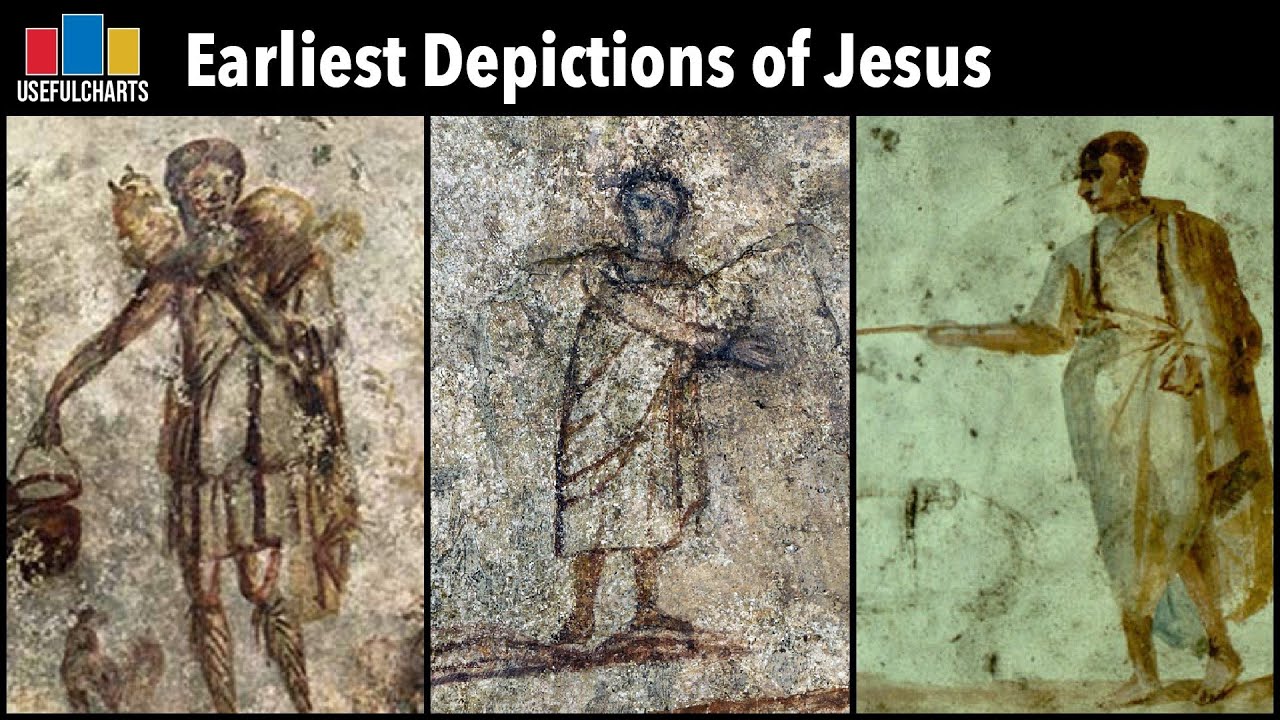
Inside the Roman catacombs, especially the Catacomb of Priscilla and the Catacomb of Domitilla, 3rd-century paintings show the Good Shepherd—a youthful, beardless figure carrying a lamb across his shoulders. Scholars read this as a symbol of Christ. While these are indirect, they are crucial steps toward the earliest jesus image we can recognise within Christian practice. The setting (burial chambers), the scriptural theme (John 10), and the repetition across sites all strengthen the identification. For a wider context on these sites, see the entry on the Catacombs of Rome and early Christian imagery.
Dura-Europos: the earliest jesus image in narrative art?
One of the strongest candidates for the earliest jesus image in a recognisable narrative scene comes from the ancient city of Dura-Europos (modern Syria), where a house church, dated to around 235 CE, preserves painted walls in its baptistry. The images include scenes scholars interpret as the healing of the paralytic, women at the tomb, and the Good Shepherd. This is among the earliest times Jesus seems to be pictured doing something specific, not merely symbolised.
The Dura-Europos finds are significant for two reasons. First, they move us from symbolic to narrative representation, which brings us closer to an identifiable figure of Jesus. Second, the artworks appear inside a space used for Christian worship and initiation, which ties the images directly to Christian practice rather than external commentary. While the faces are stylised and the identifications debated, the balance of evidence suggests these may well include the earliest jesus image in a narrative context. For more, see this introduction to the Dura-Europos church and its baptistry paintings.
From symbols to a face: when did Christians agree on Jesus’s look?
The earliest jesus image to show a “portrait” rather than a symbol likely appears later, especially in the eastern Mediterranean. By the 5th–6th centuries, Christians increasingly depicted Christ with long hair and a beard, modelled on Late Antique philosopher portraits. The most famous early panel is the Christ Pantokrator icon at Saint Catherine’s Monastery on Sinai, usually dated to the 6th century. This painting offers a frontal, arresting image that influenced countless later icons. You can explore the object via the overview on the Sinai Christ Pantokrator icon.
Why this shift? As Christianity became legal and then official within the Roman Empire, artists were freer to create devotional images. In the West, frescoes and mosaics adopted Roman artistic conventions; in the East, icon workshops developed formal styles for worship. Debates over images, especially during the Byzantine iconoclasm controversies, shaped how images were defended and used. If you are interested in how traditions later diverged and how they both approach iconography, see this clear comparison of Orthodox vs Catholic perspectives.
How scholars date contenders for the earliest jesus image
Dating early Christian art is a careful, multi-step process. To evaluate any claim about the earliest jesus image, researchers lean on:
- Archaeological context: Where was it found? In a church, home, catacomb, or rubbish heap? Associated coins, pottery, or inscriptions can anchor dates.
- Style and iconography: How does the image compare with known works? Motifs like the Good Shepherd, the orant (praying figure), or miracles from the Gospels help identify subjects.
- Materials and technique: Pigments, plasters, wood panels, and textile weaves can be characteristic of certain eras.
- Scientific methods: Radiocarbon dating, pigment analysis, and imaging can confirm or challenge proposed dates.
- Textual parallels: References in early Christian writings to images or practices can offer indirect support.
Given this toolkit, scholars are naturally cautious. The earliest jesus image is unlikely to be a single object everyone agrees on; rather, it is a small cluster of early items with varying levels of certainty, from graffiti and catacomb paintings to house-church frescoes and early icons.
Common misconceptions about the earliest jesus image
Several misunderstandings regularly cloud the conversation. Distinguishing myth from evidence will help you approach the earliest jesus image with a clear head.
- “We have a photograph-like portrait from the 1st century.” No such object has been verified. A handful of artefacts are occasionally promoted online, but none has passed rigorous peer review.
- “The Shroud of Turin is the first portrait.” Whatever one’s view of the Shroud, it is a textile with a debated date. It is not a painted portrait. For broader context on imagery traditions, see the overview of depictions of Jesus across centuries.
- “Early Christians avoided images altogether.” The record is more mixed. While some communities were cautious, the catacombs and Dura-Europos show that Christians used images relatively early, especially to teach and commemorate.
- “Pagan art means pagan belief.” Early Christians borrowed visual languages from their culture—shepherds, philosophers, imperial motifs—while giving them new meanings. For readers interested in how Christian feasts and imagery intersected with earlier practices, this article on questions about Easter’s origins offers useful background.
In short, the earliest jesus image grew out of a living conversation with the art of the Greco-Roman world. Borrowing the look of a wise philosopher or a caring shepherd did not mean adopting pagan theology; it meant translating the Gospel into familiar visual language.
Why the earliest jesus image matters today
For many believers, images are windows into devotion; for others, they are historical artefacts. The earliest jesus image matters to both groups. Historically, it anchors how Christian identity formed in real places with real materials. Spiritually, it shows how the faithful imagined grace and guidance—often through the Good Shepherd and scenes of healing and resurrection.
The earliest jesus image also reminds us that Christianity has never been culturally isolated. From Syria to Rome, from catacombs to Sinai, Christians adapted and refined how they pictured Jesus, shaping art for centuries to come.
How to assess new claims about the earliest jesus image
From time to time, headlines announce a “newly found” earliest jesus image. Some discoveries are genuine and exciting; others are overhyped. Use this simple checklist to read news with a calm, informed eye.
- Source: Is the claim in a peer-reviewed journal or a museum report? Or is it only in viral posts?
- Context: Where was the item found, and who excavated it? Reliable finds have clear provenance.
- Dating: How was the date established—archaeology, scientific analysis, or stylistic comparison?
- Identification: What makes the figure Jesus? Is there an inscription, or is it a common motif like a shepherd?
- Consensus: Are multiple experts commenting, and do they agree? Early hypotheses often change.
When evaluated with these questions, most claims settle into perspective. The earliest jesus image remains an open, evidence-led enquiry—fascinating precisely because the puzzle is still being assembled.
Recommended external resources
- Depictions of Jesus: historical overview of styles, symbols, and chronology
- Catacombs of Rome: contexts for early Christian imagery
- Dura-Europos church: one of the earliest house churches with wall paintings
- Christ Pantokrator (Sinai): an early and influential face of Christ
Frequently asked questions about earliest jesus image
What is the strongest candidate for the earliest jesus image?
It depends on what you mean by “image.” If you include hostile depictions, the Alexamenos graffito (2nd–3rd century) may be the earliest. If you want devotional art used by Christians, 3rd-century catacomb paintings of the Good Shepherd, and especially the Dura-Europos house-church frescoes (c. 235 CE), are leading candidates. Each represents an early step toward the earliest jesus image in a recognisable Christian setting.
When did Jesus start being shown with a beard?
By the 5th–6th centuries, a bearded Jesus becomes increasingly common, associated with the image of Christ as a wise teacher or Pantokrator. Earlier depictions—especially the Good Shepherd—often show a youthful, beardless figure. The Sinai Christ Pantokrator (6th century) is a key landmark in this development and influenced later icons.
Do we have any images from Jesus’s lifetime?
No verified images from Jesus’s lifetime survive. The earliest jesus image candidates appear generations later, in the 2nd and 3rd centuries, when Christianity had spread across the Roman Empire. These images reflect how early believers remembered and taught the stories of Jesus rather than documentary portraits from his lifetime.
Is the Shroud of Turin the earliest jesus image?
The Shroud of Turin is a unique textile with an image many associate with Jesus, but its date and origin are debated. It is not a painted portrait and does not function like the catacomb or Dura-Europos artworks. For the specific question of the earliest jesus image in art used by Christians, catacomb frescoes and the Dura-Europos baptistry paintings are earlier and more directly attested.
Why are some early images so hard to identify?
Early Christian art used symbols shared with broader Greco-Roman culture. A shepherd, a banquet, or a wise teacher could mean many things. Context—where the art appears and what other symbols accompany it—helps us decide whether a scene represents Jesus or a more general theme. This ambiguity is part of why the search for the earliest jesus image requires careful, multidisciplinary study.
What role did East and West play in shaping the face of Christ?
Both eastern (Greek- and Syriac-speaking) and western (Latin-speaking) Christians contributed to how Jesus was pictured. Eastern traditions formalised the icon of Christ Pantokrator; western churches developed mosaics and frescoes with local stylistic flavours. For a broader sense of the later differences in worship and art, you might explore an overview of Orthodox vs Catholic traditions.
Are claims about pagan influence a problem for early Christian images?
Not necessarily. Early Christians communicated in the visual language of their time, reinterpreting familiar motifs to express the Gospel. Adapting a shepherd or philosopher type does not imply pagan belief. If you are curious about how Christian practices absorbed and transformed earlier cultural elements, this discussion of the historical roots of Easter provides helpful context.
Conclusion on earliest jesus image
The hunt for the earliest jesus image is a journey through fragile walls, fading paint, and the living memory of the first Christian communities. While no single picture answers every question, a clear thread runs from symbolic scenes in the catacombs to narrative frescoes at Dura-Europos and, later, to the commanding portraits of Christ Pantokrator. Each step adds to our understanding of how faith became visible.
When you hear bold headlines about a new “first,” remember the tools scholars use—context, dating, iconography—and test the claim calmly. The earliest jesus image is best understood as a set of early witnesses rather than a single, definitive portrait. That set includes mocking graffiti, hopeful frescoes of the Good Shepherd, and the earliest narrative scenes of healing and resurrection.
Far from reducing mystery, this layered story enriches it. The earliest jesus image shows how believers, under diverse conditions, translated the Gospel into pictures that taught, comforted, and inspired. It invites us to look again at familiar faces of Christ, seeing behind them centuries of careful craft and faithful imagination.
